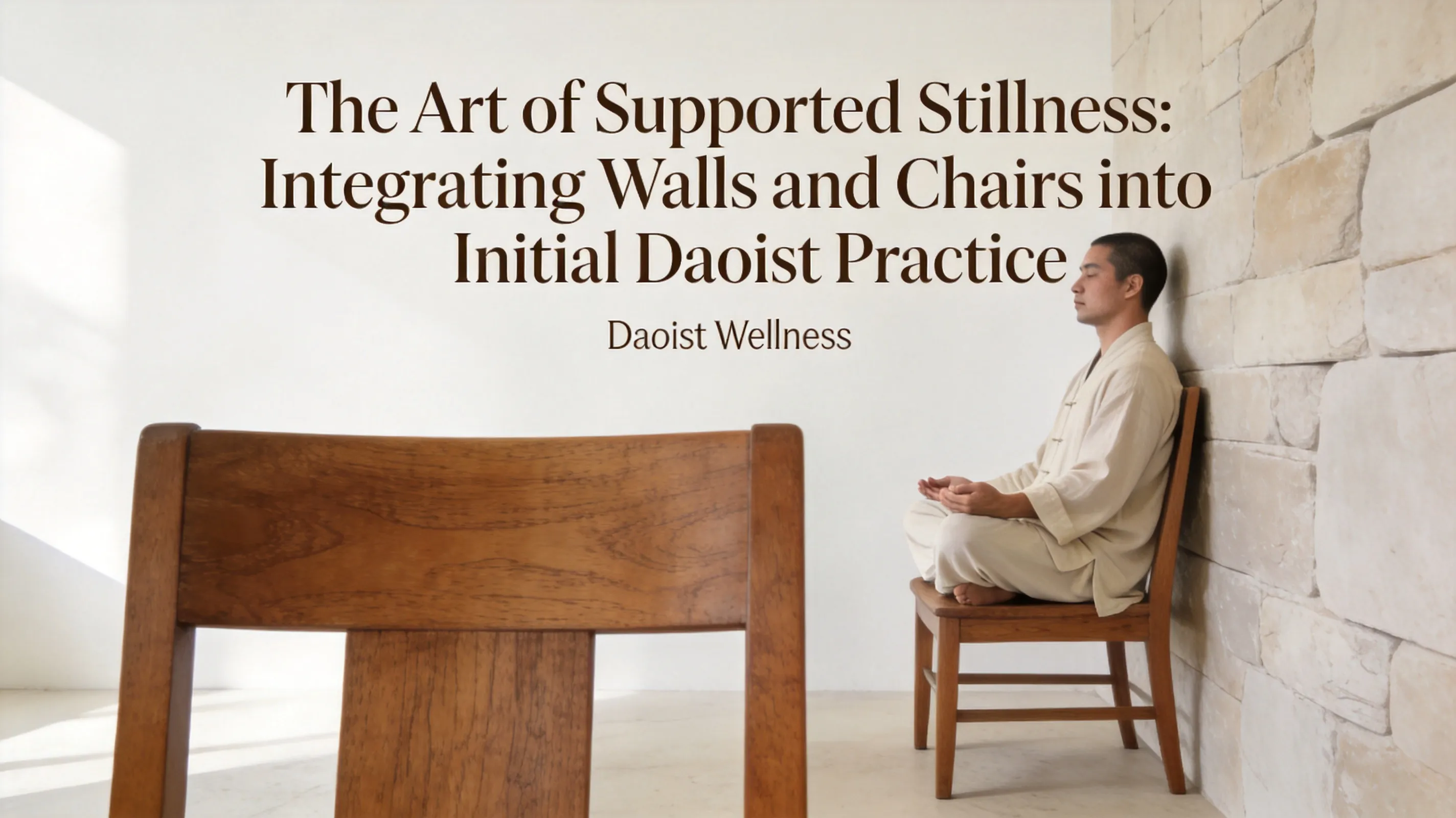
The Art of Supported Stillness: Using Walls and Chairs in Daoist Practice
In the modern world, the pursuit of Daoist cultivation often meets the reality of the contemporary physique. Many who begin the journey toward internal harmony find that their bodies, shaped by years of sedentary living and high-stress environments, carry significant tension in the lower back, hips, and spine. In traditional Daoist thought, the body is seen as a vessel for Qi (vital energy). If the vessel is strained or collapsed, the flow of energy becomes turbulent or stagnant. Therefore, the use of external supports—such as a wall or a sturdy chair—is not a sign of weakness, but a sophisticated application of Wu Wei (effortless action). By utilizing support, we remove the physical obstacles to internal stillness, allowing the practitioner to focus on the refinement of spirit and the circulation of breath.
This guide explores how to bridge the gap between modern physical limitations and ancient internal goals. By leveraging structural support, we can cultivate the correct skeletal alignment necessary for the Zhong Mai (Central Channel) to open, ensuring that the initial stages of practice are productive, safe, and deeply nourishing.
The Philosophy of Support: Stability Before Transformation
The Daoist path is one of gradual refinement. In the Neiye (Inward Training), it is suggested that when the body is correct and the blood and Qi are at peace, the mind will become stable. For a beginner, trying to hold a perfect cross-legged posture on a floor cushion can often lead to more harm than good. When the knees are high and the lower back is rounded, the diaphragm is compressed, and the nervous system enters a state of "fight or flight" due to physical discomfort. This is the antithesis of the Dao.
Using a wall or a chair allows the practitioner to find Song (active relaxation). Song is often translated as "relaxation," but in a martial or meditative context, it refers to the release of unnecessary muscular tension while maintaining structural integrity. By leaning against a wall or sitting on a chair, we provide the nervous system with a "sense of safety." When the body feels supported, the muscles of the psoas and the pelvic floor can finally release, allowing the Qi to sink into the Lower Dantian (the primary energy center below the navel).
Benefits of Using a Wall for Support
The wall is an uncompromising teacher. It provides immediate feedback regarding the alignment of the spine and the positioning of the head. In Daoist standing practices, such as Zhan Zhuang, or seated meditation, the wall serves several vital functions:
-
Spinal Decompression: By pressing the sacrum and the back of the head lightly against a flat surface, the practitioner can encourage the natural curves of the spine to lengthen. This creates space between the vertebrae, facilitating better nerve conduction and Qi flow.
-
Feedback for the "Three Points": In Daoist posture, we seek to align the sacrum, the area between the shoulder blades (the Gia Ji gate), and the occiput. A wall makes these points of contact tangible, helping the practitioner correct a forward-leaning head or an exaggerated lumbar curve.
-
Conservation of Jing: When the body is struggling to stay upright, it consumes Jing (essence/physical energy). By leaning against a wall, we minimize this consumption, redirecting that energy toward internal observation and breath regulation.
-
Grounding the Kidney 1 Point: Standing against a wall helps stabilize the weight distribution over the Yongquan (Bubbling Spring) point on the soles of the feet, connecting the practitioner more effectively to the Earth's energy.
The Virtue of the Chair: Meditation for the Modern Body
For many, the chair is viewed as a symbol of modern stagnation. However, in the context of Daoist wellness, a chair can be transformed into a powerful tool for cultivation. Sitting in a chair is often preferable to sitting poorly on the floor, as it allows for a 90-degree angle at the hips and knees, which keeps the inguinal folds (the Kua) open. When the Kua is open, blood and energy flow more freely to the lower extremities.
-
Opening the Microcosmic Orbit: A chair allows the practitioner to keep the torso vertical without the strain of tight hip flexors. This verticality is essential for the Xiao Zhou Tian (Microcosmic Orbit) meditation, where energy rises up the spine and descends down the front of the body.
-
Accessibility: Using a chair makes the profound benefits of Daoist breathwork accessible to those with knee injuries, limited flexibility, or chronic pain. It ensures that the "Gate of Life" (Mingmen, located between the kidneys) remains open and uncompressed.
-
Integration: Practicing in a chair allows the student to integrate Daoist principles into their daily life. One can practice "Sitting in Oblivion" (Zuowang) even in an office environment, turning a mundane space into a place of sacred cultivation.
Practical Tips for Wall-Supported Practice
When using a wall for support, the goal is not to "slump" against it, but to use it as a vertical reference. Follow these steps to ensure your practice remains aligned with Daoist principles:
-
The Base: Stand or sit with your heels approximately two to four inches away from the baseboard. This allows the buttocks to rest against the wall without forcing the lower back into an unnatural arch. If you are sitting on a cushion against the wall, ensure your sit-bones are firmly grounded.
-
The Three Contacts: Seek to have your sacrum, the space between your shoulder blades, and the back of your head (at the level of the jade pillow) touching the wall. Do not force the lower back to be flat against the wall; a small natural gap is normal, but it should not be a deep hollow.
-
Tucking the Chin: Gently tuck the chin in toward the throat. This opens the Yuzhen (Jade Pillow) gate at the base of the skull, allowing the Shen (spirit) to rise. The wall helps you feel if your head is tilting back, which is a common mistake that "leaks" energy.
-
The Breath: As you feel the support of the wall, focus on Abdominal Breathing. Feel the lower back expand slightly toward the wall on the inhale. This "breathing into the back" is a key secret in Daoist internal arts for nourishing the kidneys.
Practical Tips for Chair-Supported Practice
A "Daoist Chair" practice requires a specific setup. A stool or a firm, flat-seated chair without armrests is ideal. Avoid soft sofas, as they cause the pelvis to tilt backward, collapsing the internal organs.
-
The Edge of the Seat: Sit on the forward third of the chair. This ensures that your legs are supporting your weight and that your spine is self-supporting. The chair provides the base, but the spine remains a "pillar of light" reaching toward the heavens.
-
The 90-Degree Rule: Ensure your feet are flat on the floor, shoulder-width apart. Your knees should be directly over your ankles, and your thighs should be parallel to the floor. If the chair is too high, place a block or book under your feet. If it is too low, sit on a firm cushion.
-
Suspending the Crown: Imagine a golden thread pulling the crown of your head (the Baihui point) toward the sky. While the sit-bones are heavy on the chair, the spine feels light and elongated. This duality of "Heavy Below, Light Above" is a core Daoist concept.
-
Hand Placement: Rest your hands on your thighs, or cradle them in the Taiji Mudra (left hand over right, thumbs touching) in your lap. This closes the energy circuit in the arms and helps center the mind in the Dantian.
Navigating the Transition: From Support to Independence
The use of a wall or chair is a means to an end, not the end itself. In the Daoist tradition, we use "skiffs" to cross the river, but we do not carry the boat on our backs once we reach the other side. As your internal strength (Neigong) develops and your Kua opens, you will find that you can maintain the same level of Song and alignment without the external support.
However, do not rush this process. It is better to practice for twenty minutes with a wall and maintain a state of "Golden Silence" than to struggle for five minutes on the floor with a distracted, pained mind. Progress in the Dao is measured by the quality of your internal state, not the "virtuosity" of your external pose. Listen to your body—this is the first step of Neiguan (Inner Observation).
Conclusion: Finding the Middle Path
The Dao De Jing reminds us that "the soft overcomes the hard." By choosing to use a wall or chair, you are choosing a "soft" approach to training. You are refusing to force your body into shapes it is not yet ready for, and instead, you are providing the conditions for it to open naturally, like a flower following the sun.
Whether you are standing against a wall to align your spine or sitting on a chair to calm your heart, remember that the true support comes from within. The external wall is merely a mirror reflecting your internal structure. The chair is a platform for your spirit to rest. By using these tools with intention and humility, you lay a solid foundation for a lifetime of health, vitality, and spiritual clarity. Embrace the support, refine your essence, and let the Dao flow through you without obstruction.