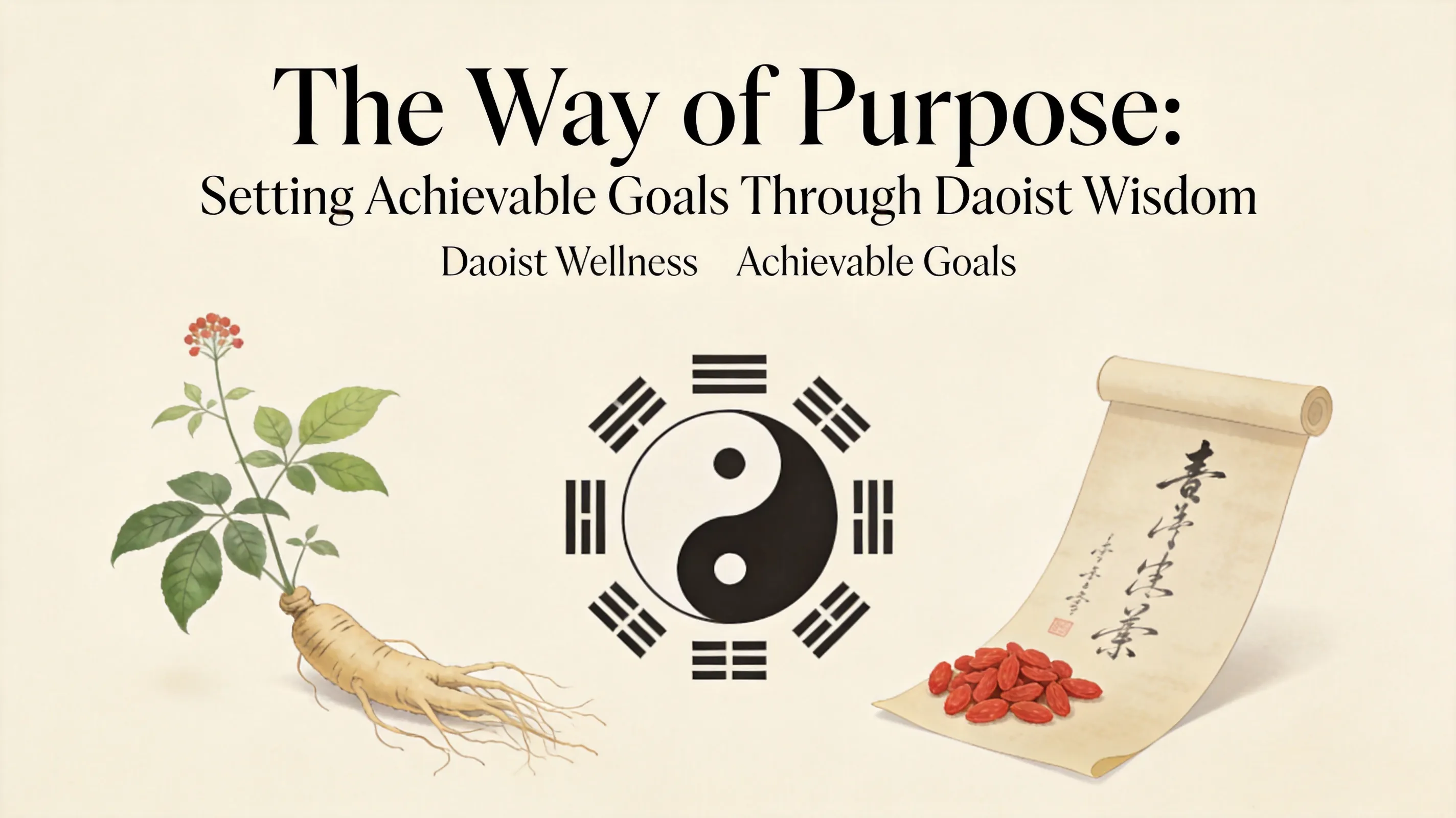
The Way of Purpose: Setting Achievable Goals Through Daoist Wisdom
In the modern world, the pursuit of goals is often depicted as a relentless struggle—a climb up a jagged mountain where only the most aggressive and forceful survive. We are told to "crush" our objectives, to "grind" through exhaustion, and to measure our worth solely by the magnitude of our external achievements. However, from the perspective of Daoist philosophy, this forceful approach often leads to burnout, internal disharmony, and ultimately, failure. The Daoist path offers a different perspective: that true achievement is not the result of friction, but of alignment with the natural flow of the universe.
Setting achievable goals is not merely a matter of time management or productivity hacks. It is a spiritual and physiological practice of finding your "Zhenren" or authentic self. When we align our desires with the "Dao"—the underlying principle of the cosmos—our goals cease to be burdens and instead become natural expressions of our being. This article explores how to integrate ancient wisdom into contemporary goal-setting, ensuring that your path is sustainable, meaningful, and deeply effective.
The Philosophy of Wu Wei in Goal Setting
At the heart of Daoist practice is the concept of "Wu Wei," often translated as "effortless action" or "non-doing." To the uninitiated, this might sound like passivity or laziness, but in the context of setting goals, Wu Wei is the highest form of efficiency. It means acting in a way that does not create unnecessary resistance. When a goal is "achievable" in the Daoist sense, it means the goal is congruent with your current capacity, your environment, and the timing of the world around you.
Imagine a swimmer trying to move against a powerful river current. They may have the strongest will in the world, but they will eventually exhaust themselves and drown. A Daoist swimmer feels the current, understands its direction, and moves in a way that utilizes the water's power to reach the shore. Setting achievable goals is the art of identifying which way the river is flowing in your own life and positioning yourself to move with it, rather than against it.
The Benefits of an Aligned Approach to Achievement
When we shift our goal-setting strategy from forceful imposition to Daoist alignment, we experience several profound benefits that enhance both our productivity and our well-being:
-
Conservation of Jing (Vital Essence): In Daoist medicine, we possess a finite amount of foundational energy. Forceful, unrealistic goals drain this essence, leading to premature aging and fatigue. Achievable goals preserve your vitality.
-
Reduced Mental Friction: By setting goals that resonate with your inner nature, you eliminate the "internal war" between what you think you "should" do and what your spirit actually desires.
-
Increased Consistency: Small, natural steps are easier to maintain than giant, forced leaps. Consistency is the "water" that eventually carves through the "stone" of any obstacle.
-
Enhanced Clarity: When you stop obsessing over distant, lofty peaks, your vision clears. You begin to see the opportunities and resources that are available to you in the present moment.
-
Long-term Fulfillment: Goals reached through the Dao bring a sense of peace rather than a fleeting "high" followed by a crash. The journey becomes as rewarding as the destination.
The Principle of Small Steps: The Journey of a Thousand Li
Laozi famously wrote in the Daodejing, "A journey of a thousand li begins with a single step." This is the foundational logic of an achievable goal. Many people fail because they focus entirely on the "thousand li" and neglect the quality of the "single step." From a wellness perspective, a goal that is too large creates a stress response in the body, triggering the sympathetic nervous system and clouding the mind with cortisol.
To make a goal achievable, you must break it down until it no longer triggers fear or resistance. If your goal is to write a book, and the thought of it makes you freeze, the goal is currently "out of alignment." Scale it back to writing one paragraph, or even one sentence. When the task feels "easy," you have found the point of Wu Wei. You are no longer fighting yourself; you are simply moving.
Practical Tips for Setting Daoist Goals
To apply these ancient principles to your daily life, consider the following practical strategies for crafting and pursuing your objectives:
1. Observe the "Internal Weather"
Before setting a goal, sit in quiet meditation. Check the state of your "Qi" (energy). Are you setting this goal out of a sense of lack, or out of a sense of abundance? Goals set from a place of insecurity or comparison are "false" goals. They are ghosts that will haunt you. An achievable goal should feel like a natural extension of your current growth, like a bud forming on a branch in spring.
2. Practice the "Rule of Three"
In Daoist cosmology, three is a number of balance—Heaven, Earth, and Humanity. Limit your primary focuses to no more than three at any given time. Attempting to pursue ten different goals scatters your "Shen" (spirit). When your spirit is scattered, your power is diluted. By focusing on three harmonious objectives, you allow your energy to gather and become potent.
3. Align with the Seasons
Nature does not bloom all year round. There is a time for planting (Spring), a time for flourishing (Summer), a time for harvesting (Autumn), and a time for resting (Winter). Apply this to your goal-setting. If you are in a personal "winter"—perhaps recovering from illness or a major life change—it is not the time to set a high-intensity professional goal. Respect the season you are in, and your goals will become much easier to achieve.
4. Embrace "Ziran" (Self-So-Ness)
Ziran refers to things happening naturally of their own accord. When setting a goal, ask yourself: "Does this path feel forced?" If you have to constantly manipulate others or compromise your integrity to reach a goal, you are out of alignment with Ziran. An achievable goal often has a quality of "coming together" where external circumstances seem to support your efforts.
5. The Power of Gentleness
The Daoist masters always emphasized that the soft overcomes the hard. In your goal pursuit, do not be a brittle branch that snaps in the wind. Be the willow that bends. If a particular method isn't working, don't double down on the force; instead, gently adjust your approach. Flexibility is a sign of life; rigidity is a sign of death.
Cultivating the "Beginner's Mind" and Letting Go of Results
One of the greatest paradoxes in Daoism is that we are most successful when we are least attached to the specific outcome. When we become obsessed with a result, we develop "attachment," which creates tension. This tension inhibits our ability to respond fluidly to the present moment.
To set an achievable goal, focus your intention on the process rather than the trophy. If your goal is weight loss, make the goal the act of eating nourishing foods and moving your body with joy, rather than a specific number on a scale. When you fall in love with the process, the results appear as a natural byproduct. This is the essence of "doing without striving." You are performing the actions required, but you are not clutching at the future.
The Role of Environment: Arranging the Outer to Support the Inner
Just as a seed requires the right soil, moisture, and light to grow, your goals require a supportive environment. This is the essence of Feng Shui—the art of placement. If your goal is to cultivate a calm mind, but your workspace is chaotic and cluttered, you are creating unnecessary resistance. To make your goals achievable, look at your surroundings. What can you remove? What can you simplify? By clearing the physical and mental "clutter," you create a vacuum that the Dao naturally fills with new opportunities and clarity.
Overcoming Obstacles with Water-Like Persistence
Inevitably, you will encounter obstacles. The Daoist approach to obstacles is not to smash through them, but to flow around them. Water is the softest substance, yet it can wear down the hardest granite. It does this through persistence and by always seeking the lowest, easiest path. When you hit a wall in your goal pursuit, do not view it as a failure. View it as the universe suggesting a change in direction. Is there a "softer" way to achieve the same result? Often, the path we didn't see is more effective than the one we were stubbornly focused on.
Conclusion: Living the Way of Achievement
Setting achievable goals is ultimately an act of self-love and cosmic alignment. It is a refusal to participate in the culture of burnout and a commitment to the cultivation of one's own life force. By embracing the principles of Wu Wei, respecting the seasons of your life, and focusing on small, consistent steps, you transform the act of "getting things done" into a sacred practice of "becoming."
Remember that you are a part of the Dao. The same intelligence that moves the stars and grows the forests is within you. When you set goals that are in harmony with this intelligence, failure becomes impossible, because every step—whether it feels like a victory or a lesson—is part of your natural unfolding. Walk your path with a light heart, a flexible mind, and a steady spirit. This is the way to true and lasting achievement.