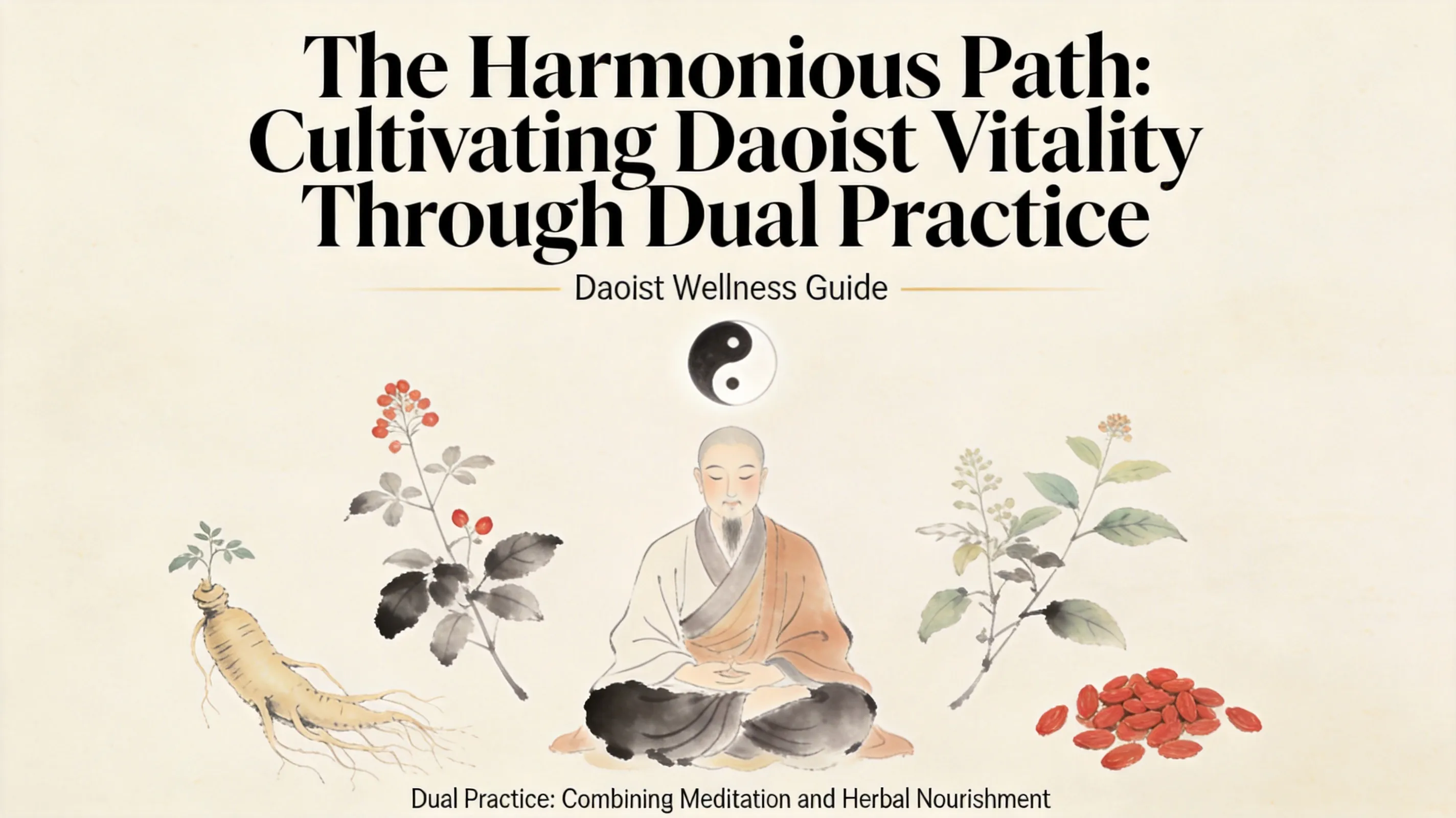
The Harmonious Path: Cultivating Daoist Vitality Through Dual Practice
In the ancient traditions of the Dao, the journey toward health, longevity, and spiritual clarity is often depicted as a solitary climb up a misty mountain. We imagine the hermit in the cave, the monk in silent meditation, or the practitioner moving through Taiji forms in the early morning fog. However, the wisdom of the Daoist classics reminds us that the universe itself is a dance of relationship. The Dao is not a static point, but a movement between polarities—Yin and Yang. While individual cultivation (Neigong) is the foundation of any serious practice, the inclusion of a partner provides a unique mirror, a source of vital feedback, and a steadying force of motivation that accelerates our internal transformation.
Practicing with a partner is more than just a social endeavor; it is a sophisticated method of balancing the external and internal landscapes. In Daoist philosophy, we speak of "Dual Cultivation," a term that historically referred to specific esoteric practices but in a modern wellness context signifies the shared journey of two individuals supporting each other’s evolution. By engaging with another, we step out of the subjective vacuum of our own minds and enter a space where our alignment, our breath, and our intent are tested against the reality of another’s presence. This article explores the profound benefits and practical applications of partner-based Daoist practice.
The Alchemy of Relationship: Why Practice Together?
The primary reason for partner practice in Daoist wellness is the concept of external feedback. When we practice alone, our "monkey mind" often convinces us that our posture is perfect, our breath is deep, and our spirit is calm. Yet, we are often blind to our own imbalances. A partner serves as a living mirror. They can see the tension in our shoulders that we cannot feel, or the collapse in our spine that we have grown accustomed to. In the Daoist view, physical misalignment is a precursor to energetic stagnation. By having a partner gently correct our frame, they help us ensure that the "Jing" (essence) can transform into "Qi" (vital energy) without obstruction.
Beyond the physical, there is the principle of resonance. When two people practice Qigong or meditation together, their energy fields—or "Wei Qi"—begin to harmonize. This is known as the "Biotonic Effect." A partner who is focused and calm can help stabilize a practitioner who is feeling scattered or fatigued. Conversely, when we know someone is waiting for us at the park or in the studio, our commitment to the "Way" is reinforced. This mutual accountability is the antidote to the "sloth and torpor" that the ancients warned could derail even the most sincere student.
The Benefits of Shared Cultivation
- **Refining Structural Integrity:** In practices like Taiji or Zhan Zhuang (standing meditation), a partner can provide light pressure to test your "root." This physical feedback tells you immediately if you are using muscular tension rather than skeletal alignment.

- **Deepening Sensory Awareness:** Through touch and shared movement, we develop "Ting Jing" or "listening power." This is the ability to sense subtle changes in another’s energy, which in turn makes us more sensitive to our own internal shifts.

- **Emotional Regulation:** The Daoist path emphasizes the "Five Virtues." Practicing with another requires patience, kindness, and humility. It forces us to move beyond the ego and cultivate a heart of service.

- **Sustained Motivation:** The "Daoist Heart" can sometimes falter. A partner provides the "Yang" spark of encouragement when our "Yin" restfulness turns into stagnation. Together, you create a rhythmic cycle of practice that is harder to break than a solo routine.

- **Enhanced Qi Flow:** Certain exercises, such as "Push Hands" or collaborative stretching, encourage the Qi to circulate through the meridians more vigorously than solitary movement often allows.
Practical Tips for Partner Practice
To engage in partner practice successfully, one must approach the sessions with a specific mindset. It is not a competition, nor is it merely a conversation. It is a shared ritual. Here are several practical ways to integrate a partner into your Daoist wellness routine.
1. Corrective Alignment and the "Light Touch"
One of the simplest and most effective partner exercises involves postural checking. While one partner stands in a Qigong posture—such as "Holding the Urn"—the other partner walks slowly around them. The observing partner looks for "Kinks in the Hose." Are the knees collapsing? Is the chin jutting out? Is the lower back arched too deeply? Instead of giving a long verbal explanation, the observing partner uses a single finger to provide a light touch on the area that needs attention. This "point-focus" allows the practitioner to bring their "Yi" (intent) to that spot and relax it from the inside out. After five minutes, the roles are reversed.
2. The Breath Resonance Technique
Sit back-to-back with your partner in a comfortable cross-legged position or on chairs. Close your eyes and begin to regulate your breathing. Initially, you will notice that your breath cycles are out of sync. Do not force a change. Simply feel the movement of your partner’s ribcage against your own. Gradually, without conscious effort, your breathing will begin to synchronize. This practice builds a deep energetic connection and teaches the body how to find harmony with the environment. It is an excellent way to lower cortisol levels and enter a state of "Wu Wei" (effortless action).
3. Sensitivity Training (Ting Jing)
Stand facing your partner with your forearms touching. Slowly, one person begins to lead a circular movement, and the other follows, maintaining the exact same level of light pressure. The goal is to never lose contact and never resist. This requires a high level of "Song" (release). This exercise teaches you how to read the intentions of others and how to remain centered even when external forces are acting upon you. It is a physical manifestation of the Daoist principle of yielding to overcome force.
4. Joint Visualization Meditation
The Daoist "Inner Smile" is a powerful practice for healing the internal organs. When practiced with a partner, you can sit facing each other and visualize a golden light flowing from your heart to theirs. As you smile into your own organs, imagine that peace and vitality are also being transmitted to your partner. This strengthens the "Shen" (spirit) and fosters a sense of profound interconnectedness, reminding us that our health is not independent of the health of our community.
The Ethics of the Shared Path
In the Daoist tradition, the teacher-student and peer-to-peer relationships are governed by "De" (virtue). When practicing with a partner, it is vital to maintain an atmosphere of mutual respect. Feedback should be given clearly but gently. If a partner is struggling with a movement, the goal is not to show how well you can do it, but to help them find their own path into the posture. We must remember that everyone’s "Body Dao" is different. What works for one person’s skeletal structure may not work for another’s. Practice sensitivity, not just in touch, but in communication.
Furthermore, it is important to establish boundaries. Daoist practice involves the movement of energy, and sometimes this can release stored emotions. A good practice partner provides a stable container for this release without becoming entangled in the drama of the emotion. Stay focused on the breath and the movement. If the practice becomes too focused on talking, the "Qi" will dissipate through the mouth rather than circulating through the "Dan Tien" (energy center).
Overcoming Challenges in Partnership
Not every session will be perfect. There will be days when one partner is full of "Yang" energy and wants to move vigorously, while the other is in a "Yin" state and needs quietude. This is not a conflict; it is an opportunity to practice "Taiji"—the balancing of extremes. On such days, find a middle ground. Perhaps start with a slow, meditative walk together before moving into more active exercises. The flexibility of the practice is what allows it to endure over many years.
Another common challenge is the "Feedback Trap," where one partner becomes overly critical. If you find yourself constantly correcting your partner, step back and return to your own internal cultivation. Remember that the best way to influence another’s energy is to refine your own. If you are truly "Song" (relaxed), your partner will often naturally mirror that relaxation without a single word being spoken. This is the "silent teaching" mentioned in the Dao De Jing.
Conclusion: The Circle Completes
The path of Daoist wellness is a journey toward wholeness. While we must eventually walk the path on our own feet, the presence of a companion makes the road clearer and the climb more joyful. Partner practice bridges the gap between the internal work of the self and the external world of relationship. It teaches us that we are not isolated islands, but part of a grand, flowing tapestry of life.
By using a partner for feedback, you refine your physical and energetic vessel. By using a partner for motivation, you ensure that your practice remains a consistent flame rather than a flickering spark. Whether you are practicing Qigong in a park, meditating in a quiet room, or exploring the subtle pressures of Push Hands, the presence of another seeker enriches the experience. In the end, the "Dao" is found in the harmony between all things. When two people cultivate together with sincerity and heart, they create a small pocket of that universal harmony here on Earth. Embrace the dual path, and let your shared practice become a source of endless vitality and wisdom.