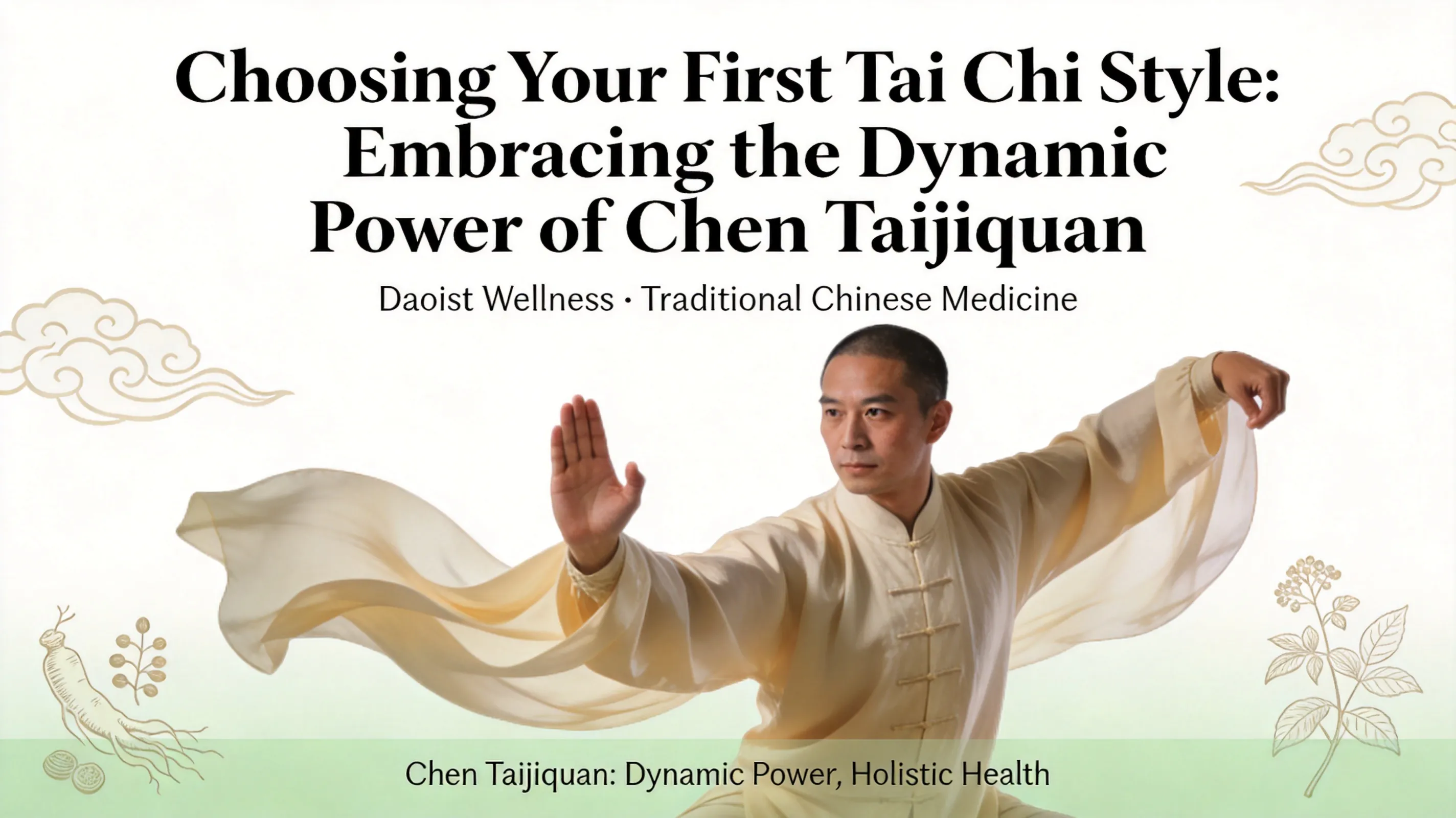
Choosing Your First Tai Chi Style: The Spiral Power of Chen Family Taijiquan
Entering the path of Tai Chi is more than just starting a new exercise routine; it is an invitation to align your physical form with the eternal flow of the Dao. In the vast landscape of internal martial arts, the newcomer is often faced with a pivotal question: Which style should I choose? For those drawn to the intersection of profound martial application, rhythmic beauty, and the cultivation of internal energy, Chen Style Taijiquan—the ancestral root of all Tai Chi—often stands as the most compelling gateway.
In Daoist thought, the universe is a constant interplay of Yin and Yang. Chen style embodies this duality more visibly than perhaps any other lineage. It is characterized by its "silk reeling" energy (Chan Si Gong), its explosive bursts of power (Fa Jin), and its alternating tempos of slow, meditative movements followed by swift, kinetic expressions. To choose Chen style as your first Tai Chi practice is to commit to a journey that honors the martial ferocity of the past while nurturing the tranquil spirit of the practitioner.
The Ancestral Origin: Understanding the Chen Legacy
To understand Chen style is to understand the history of Tai Chi itself. Developed in Chenjiagou (Chen Village) in Henan Province, this style dates back several centuries, credited largely to the 9th generation ancestor Chen Wangting. By integrating military training with ancient Daoist breathing techniques (Tu Na) and the mapping of TCM meridians, the Chen family created a system that was as effective for self-defense as it was for longevity.
When you choose Chen style as your first practice, you are drinking from the source. While other styles like Yang, Wu, or Sun evolved later—often softening the movements to make them more accessible to the general public or the imperial courts—Chen style has retained its original martial texture. It remains a "complete" system that doesn't shy away from the physical rigors of low stances and dynamic rotations. For the beginner, this provides a clear, unadulterated roadmap of how internal energy (Qi) translates into external movement.
The Core Principles of Chen Style Taijiquan
Before diving into the practice, it is essential to understand the Daoist mechanics that define the Chen experience. If you are looking for a practice that challenges your coordination and deepens your connection to your body's "center," these principles will resonate with you:
- **Silk Reeling (Chan Si Gong):** This is the signature of Chen style. It involves continuous, spiral movements that originate in the feet, are governed by the waist (Dantian), and manifest in the fingertips. Like pulling silk from a cocoon, the movement must be consistent—neither too fast nor too slow—or the thread will break.

- **Fa Jin (Explosive Power):** Unlike the purely soft appearance of Yang style, Chen style includes visible releases of energy. This teaches the practitioner how to transition instantly from total relaxation (Sung) to focused impact, mimicking the sudden crack of a whip.

- **Alternating Tempo:** Chen forms are not performed at a singular speed. They flow like a river; sometimes the water is still and deep, and sometimes it crashes over rocks. This variability trains the nervous system to remain calm during sudden changes.

- **The Dantian Focus:** All movement rotates around the lower Dantian, located in the lower abdomen. In Daoist alchemy, this is the cauldron where energy is refined. Chen style’s emphasis on waist rotation ensures this center is constantly stimulated.
The Physical and Spiritual Benefits of Chen Style
Choosing Chen style as your first martial art offers a multifaceted array of benefits that address the body, mind, and spirit in unison. Because it is more physically demanding than some other styles, the rewards often manifest more tangibly in the early stages of training.
1. Strengthening the Root and Foundation**Chen style utilizes lower stances (Ma Bu) and complex weight shifting. For the beginner, this builds significant leg strength and bone density. In Daoism, "rooting" is the ability to connect one’s energy to the earth. By strengthening the lower body, you create a stable vessel for the spirit to inhabit. A strong root leads to a calm mind.
<strong>2. Enhancing Joint Mobility and Fascial Health****The spiral nature of silk reeling exercises works the joints through their full range of motion. Unlike linear exercises, these rotations hydrate the fascia and connective tissues. This is particularly beneficial for those looking to prevent injury or reverse the stiffness associated with modern sedentary lifestyles.
<strong>3. Cultivation of Internal Energy (Qi)****Through the synchronization of breath and movement, Chen style encourages the flow of Qi through the twelve primary meridians. The specific twists and turns of the form act as a self-massage for the internal organs, promoting better digestion, circulation, and immune function. Practitioners often report a "warmth" or "tingling" sensation early in their training—a sign of the internal energy awakening.
<strong>4. Psychological Resilience and "Stillness in Motion"****The complexity of Chen style requires total mental presence. You cannot "zone out" while performing a Chen form. This intense focus acts as a form of moving meditation, clearing the mind of anxiety and ruminative thoughts. It teaches you to remain centered and "Sung" (relaxed but alert) even when the movement becomes fast or difficult—a vital skill for navigating the stresses of daily life.
Is Chen Style Right for You?
While every style of Tai Chi is beneficial, Chen style is particularly suited for specific types of students. You might find Chen style to be your ideal first choice if:
- <strong>You enjoy a physical challenge:** If you find the thought of very slow, uniform movement slightly monotonous, the variety in Chen style will keep you engaged.

- **You are interested in martial arts:** If you want to understand the "why" behind the movements—how a palm strike or a shoulder bump actually works—Chen style provides the clearest martial context.

- **You want to improve athleticism:** Athletes often choose Chen style to improve their balance, coordination, and explosive power for other sports.

- **You are seeking Daoist depth:** If you are interested in the "Internal Alchemy" (Neidan) aspect of Chinese arts, the spiral movements of Chen style offer a sophisticated method for energetic cultivation.
Practical Tips for the Beginning Chen Practitioner
Starting Chen style can feel overwhelming due to its complexity. However, by approaching the practice with a "Daoist heart"—one that is patient, open, and humble—you will find the path unfolds naturally. Here are several tips for your first few months:
Seek a Qualified Teacher: Because of the intricate nature of silk reeling and Fa Jin, it is difficult to learn Chen style accurately from videos alone. Look for a teacher who can trace their lineage back to the Chen village and who emphasizes "Sung" (relaxation) over raw muscular tension.
Focus on the "Old Frame" (Lao Jia): Beginners typically start with Lao Jia Yi Lu (The First Form of the Old Frame). This form focuses on developing the foundation, opening the joints, and establishing the silk reeling energy. Don't rush to learn the "Cannon Fist" (Er Lu) or weapons; the secrets of the art are hidden in the slow, foundational movements of the first form.
Prioritize Relaxation (Sung): The most common mistake beginners make is using too much muscular force. In Tai Chi, power comes from the release of tension, not the creation of it. Always check your shoulders, jaw, and chest—if they are tight, your Qi will be blocked.
Practice Your Silk Reeling Daily: Even if you only have ten minutes, practice the basic standing silk reeling exercises. These are the "alphabet" of the Chen language. Once these circular movements become second nature, the complex sequences of the form will become much easier to memorize.
Listen to Your Knees: Chen style involves deep knee bends and rotations. It is imperative that your knees always align with your toes. Never twist the knee joint; the rotation must come from the hip (the Kua). A good instructor will prioritize your structural alignment to ensure your practice leads to health, not injury.
The Daoist Perspective: Harmonizing the Self
In the Dao De Jing, Laozi observes that "the soft and weak overcome the hard and strong." At first glance, the explosive power of Chen style might seem to contradict this. However, the Fa Jin of Chen Taijiquan is only possible because of extreme softness. Without relaxation, the energy cannot travel through the body to the point of impact. It is the ultimate expression of the "flexible" overcoming the "rigid."
By choosing Chen style, you are practicing the art of harmonization. You are learning when to be soft and when to be firm, when to expand and when to contract. This balance, known as the "Taiji" point, is the center of the Daoist universe. As you move through your form, you are not just exercising; you are performing a ritual that harmonizes your Microcosm (the body) with the Macrocosm (the universe).
Conclusion: The First Step on a Lifelong Journey
Choosing Chen style as your first Tai Chi experience is a bold and rewarding decision. It offers a path that is as aesthetically beautiful as it is martially profound. It will challenge your body, sharpen your mind, and provide you with a toolset for health that will serve you for the rest of your life.
Remember that the journey of a thousand miles begins with a single step—or in this case, a single circle. Do not be discouraged by the complexity of the movements. In the beginning, there is often confusion; in the middle, there is effort; but in the end, there is flow. By embracing the spirals of Chen style, you are aligning yourself with the natural spirals of the galaxies and the DNA within your cells. You are returning to the source.
Approach your first class with the "beginner's mind"—free from expectation and full of curiosity. The Chen family legacy is now yours to explore. Through diligent practice, patience, and the cultivation of "Sung," you will find that Tai Chi is not just something you do; it is something you become.