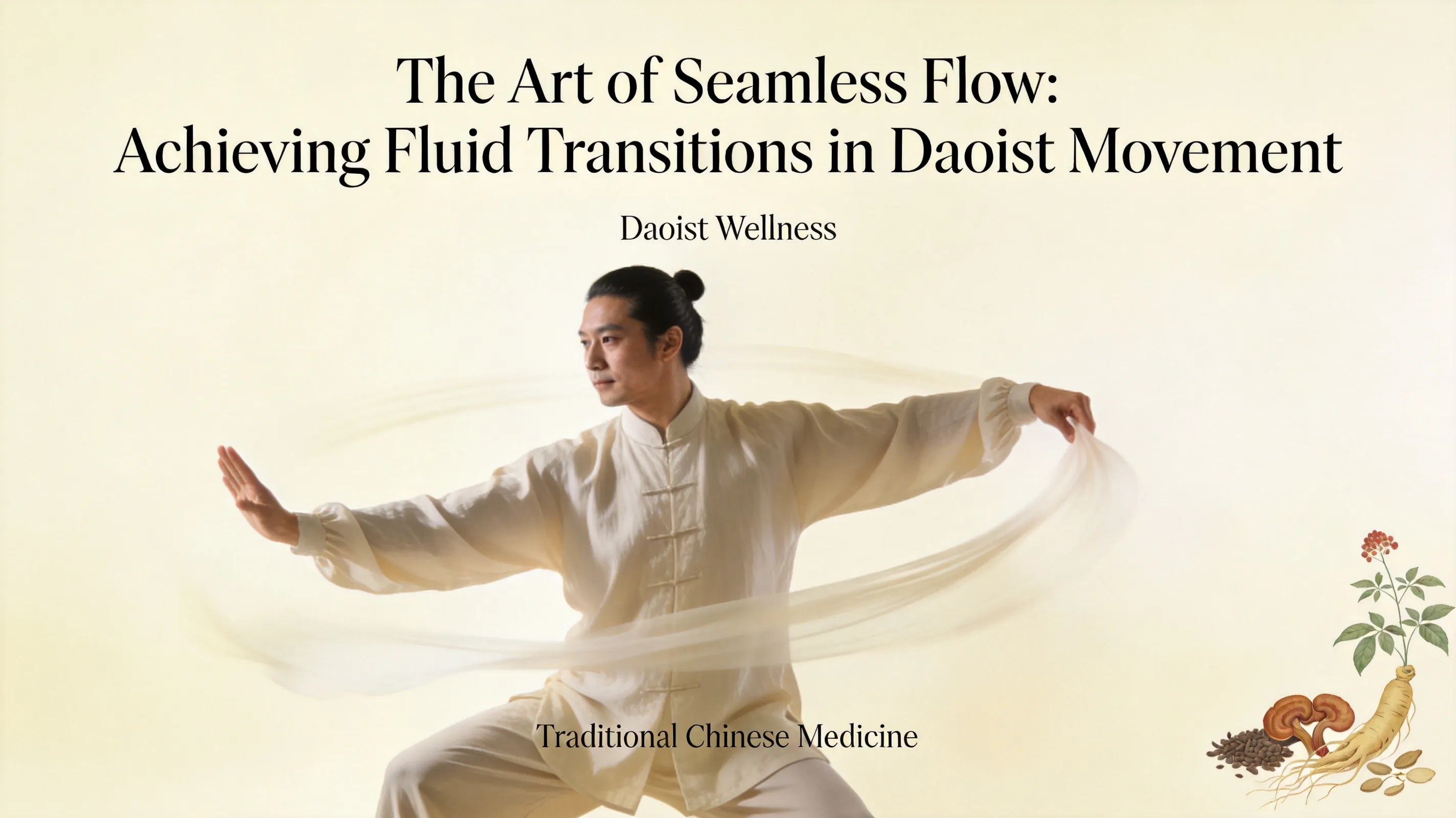
The Art of Seamless Flow: Transitioning Between Postures in Daoist Practice
In the practice of Daoist movement arts, whether it be Taiji, Qigong, or Daoyin, the physical posture is often viewed as a vessel for the breath and the spirit. However, many practitioners find themselves encountering a common obstacle: the "jerk" or the "break" between movements. These abrupt transitions act as interruptions in the flow of Qi, creating stagnation where there should be circulation. To master the art of Daoist wellness is to understand that the movement is not a series of static snapshots, but a continuous, unbreakable thread of intention. In this exploration, we delve into the philosophy and mechanics of smooth transitions, moving beyond mechanical repetition into the realm of effortless flow.
The concept of Wu Wei, or non-forcing action, is central to this transition. When we jerk or snap into a position, we are using localized muscular force—a manifestation of "hard" energy that opposes the natural rhythm of the body. To transition smoothly is to align with the Dao, allowing one movement to birth the next, much like the changing of the seasons or the ebb and flow of the tide. This article provides a comprehensive guide to refining your practice, ensuring that every transition is as deliberate and graceful as the posture itself.
The Philosophy of the Unbroken Thread
In classical Daoist texts, movement is often compared to "drawing silk from a cocoon." If you pull too fast or with a sudden jerk, the delicate thread breaks. If you pull too slowly or without consistent tension, the thread tangles. This metaphor perfectly encapsulates the requirement for transitions. The energy (Qi) must remain constant and connected from the beginning of the practice session to the end.
When we look at the structure of a transition, we must realize that there is no true "end" to a movement. In the Daoist worldview, the end of Yin is the beginning of Yang. When a movement reaches its furthest extension, it does not stop; it folds, rotates, or dissolves into the next phase. If you treat each posture as an isolated goal, your body will naturally decelerate and then "re-start" for the next move, causing a visible jerk. By shifting your focus to the space between the postures, you maintain the "Internal Silk," keeping the nervous system calm and the fascia hydrated.
The Benefits of Smooth Transitions
Refining the way you move between postures offers profound benefits that extend beyond the practice mat. By eliminating jerky movements, you are essentially retraining your nervous system to operate from a state of relaxation rather than stress. Here are the primary benefits of mastering fluid transitions:
- **Enhanced Qi Circulation:** Smooth movement prevents "leaks" and blockages in the meridians. Just as a kinked garden hose stops the flow of water, a jerky movement temporarily halts the flow of internal energy. Fluidity ensures that the Qi reaches the extremities consistently.

- **Joint Longevity and Safety:** Jerking movements place sudden, uneven stress on the tendons and ligaments. By transitioning smoothly, you use the body's natural tensegrity—the balance of tension and compression—to protect the joints from wear and tear.

- **Cultivation of Ting (Listening) Power:** To move without jerking, you must develop a high degree of internal sensitivity. This "listening" allows you to detect tension before it becomes a physical hitch, fostering a deep mind-body connection.

- **Stress Reduction:** Abrupt movements trigger the sympathetic nervous system (fight or flight). Smooth, rhythmic transitions engage the parasympathetic nervous system, inducing a meditative state that lowers cortisol and promotes healing.

- **Improved Balance and Rooting:** Jerks usually stem from a lack of stability. Learning to transition smoothly requires you to maintain your "center" at all times, leading to a more profound sense of being rooted to the earth.
The Mechanics of Fluidity: Why We Jerk
Before we can fix the transition, we must understand why the jerk occurs. In most cases, it is a result of one of three things: a break in intention, a lack of structural integration, or the "dead stop" syndrome. The human brain likes to categorize things into "start" and "finish." When the brain checks a movement off as "done," the muscles relax prematurely, and the structural alignment collapses. To start the next movement, the body must then overcome inertia with a sudden burst of effort—the jerk.
Another common cause is the "shifting of the weight." In Taiji and Qigong, many transitions involve moving the weight from one leg to another. If the weight is dropped suddenly rather than poured like water, the body experiences a shock. Daoist wellness teaches us to "pour" the weight, maintaining a constant level of the hips and a steady engagement of the core (Dantian).
Practical Tips for Smooth Transitions
Achieving a seamless flow requires a combination of mental focus and physical adjustment. Use the following principles to refine your transitions and eliminate jerky movements from your practice.
1. Lead with the Dantian
In Daoist movement, the Dantian (the center of gravity located in the lower abdomen) is the commander. Most jerks happen because the hands or feet move before the center. When the extremities move independently, they lack the support of the whole body, leading to disjointed motion. Always initiate the transition from the Dantian. Let the center turn first, and let that rotation pull the limbs into place. When the whole body moves as one unit, the transitions become naturally smooth.
2. The Principle of the "Micro-Bend"
A common mistake is locking the joints at the end of a movement. A locked elbow or knee creates a mechanical "dead end." To keep the flow, always maintain a micro-bend in the joints. This allows the energy to "bounce" or "cycle" back rather than hitting a wall. Think of your limbs as supple bamboo rather than stiff timber. The micro-bend keeps the muscles active but relaxed, ready to transition in any direction without a restart.
3. Use the "Four-Ounce" Intention
The classics state, "Use intention, not brute force." If you find yourself jerking, you are likely using too much muscular effort. Try practicing your transitions with only ten percent of your maximum strength. Focus on the sensation of the air against your skin. By lowering the physical force, you allow the internal connections to take over. This "four-ounce" approach creates a velvety smoothness that is impossible to achieve through sheer muscular tension.
4. Coordinate the Breath as a Bridge
The breath is the bridge between the mind and the body. Jerky movements often coincide with holding the breath or a shallow, ragged breathing pattern. To smooth out a transition, ensure the breath is continuous. Never "hold" your breath at the end of a posture. Instead, let the end of the inhalation be the pivot point where the exhalation begins. The breath should act as a lubricant for the movement; as long as the breath is flowing, the body cannot truly stop.
5. Visualize "Moving Through Water"
Visualization is a powerful tool in Daoist wellness. Imagine that you are submerged in chest-deep water. To move quickly or abruptly would create turbulence and resistance. To move smoothly, you must feel the pressure of the water against your entire body. This visualization encourages a constant, even speed. If one part of the transition is faster than another, the "water" provides feedback. Aim for a consistent velocity throughout the entire form.
The Role of the Eyes and Spirit (Shen)
In Daoism, the "Eyes follow the hand, and the Heart-Mind follows the eyes." Often, a jerk occurs because the gaze jumps ahead to the next position before the body has finished the current one. This creates a mental disconnect. To ensure a smooth transition, keep your focus soft but present. Your internal "gaze" should lead the movement, but it should do so like a light illuminating a path, not a hook pulling the body forward. When your spirit (Shen) is calm and centered, your physical movements will reflect that tranquility.
Consider the transition as the most important part of the movement. Most practitioners focus on the "peak" of the posture because that is what looks good in a photograph. However, the true "Kung Fu" (skill developed through time) is found in the "valleys" between the peaks. Treat the transition with the same respect and mindfulness as the posture itself.
Common Pitfalls to Avoid
- **The "Stop-Go" Habit:** Avoid pausing completely between movements unless the specific style calls for it. Even in "Stillness Qigong," there is an internal vibration of movement.

- **Collapsing the Frame:** Do not let your posture "wilt" during the transition. Maintain the "Peng" (expansive) energy in your limbs at all times.

- **Rushing the Difficult Parts:** We tend to jerk through movements we find balance-challenging or complex. Slow down specifically during the parts you find most difficult.

- **Losing the Root:** Ensure your connection to the ground is not broken during weight shifts. If your heel or toe pops up unexpectedly, a jerk will follow as you regain balance.
Integration into Daily Life
The goal of Daoist wellness is not just to move beautifully for thirty minutes a day, but to carry that grace into the world. You can practice smooth transitions while performing mundane tasks. When you reach for a cup of tea, do it without a jerk. When you stand up from a chair, let the movement be a "pour" of energy rather than a mechanical heave. By practicing fluidity in small ways, you reinforce the neural pathways of smooth movement, making it your natural state of being.
This "Everyday Daoyin" turns life into a continuous flow. When we stop jerking through our physical actions, we often find that our emotional and mental transitions become smoother as well. We become less reactive to stress and more adaptable to change, embodying the fluid nature of water—the highest virtue in Daoist philosophy.
Conclusion: The Endless Circle
Mastering the transition is a lifelong journey. It is the process of removing the "kinks" from our physical and energetic bodies. As you continue your practice, remember that the circle is the fundamental shape of the Dao. A circle has no beginning, no end, and no corners. By smoothing out the jerks in your movement, you are rounding off the corners of your own nature.
Be patient with yourself. The habit of jerking is often the result of years of hurried living and disconnected movement. With consistent, mindful practice, the "silk thread" of your Qi will become strong, continuous, and unbreakable. Your transitions will become invisible, and your practice will transform from a series of exercises into a single, beautiful dance with the Dao.
In the silence between the notes, there is music. In the transitions between the postures, there is the Dao. Seek the flow, maintain the center, and let your movement be as effortless as the clouds drifting across the sky.