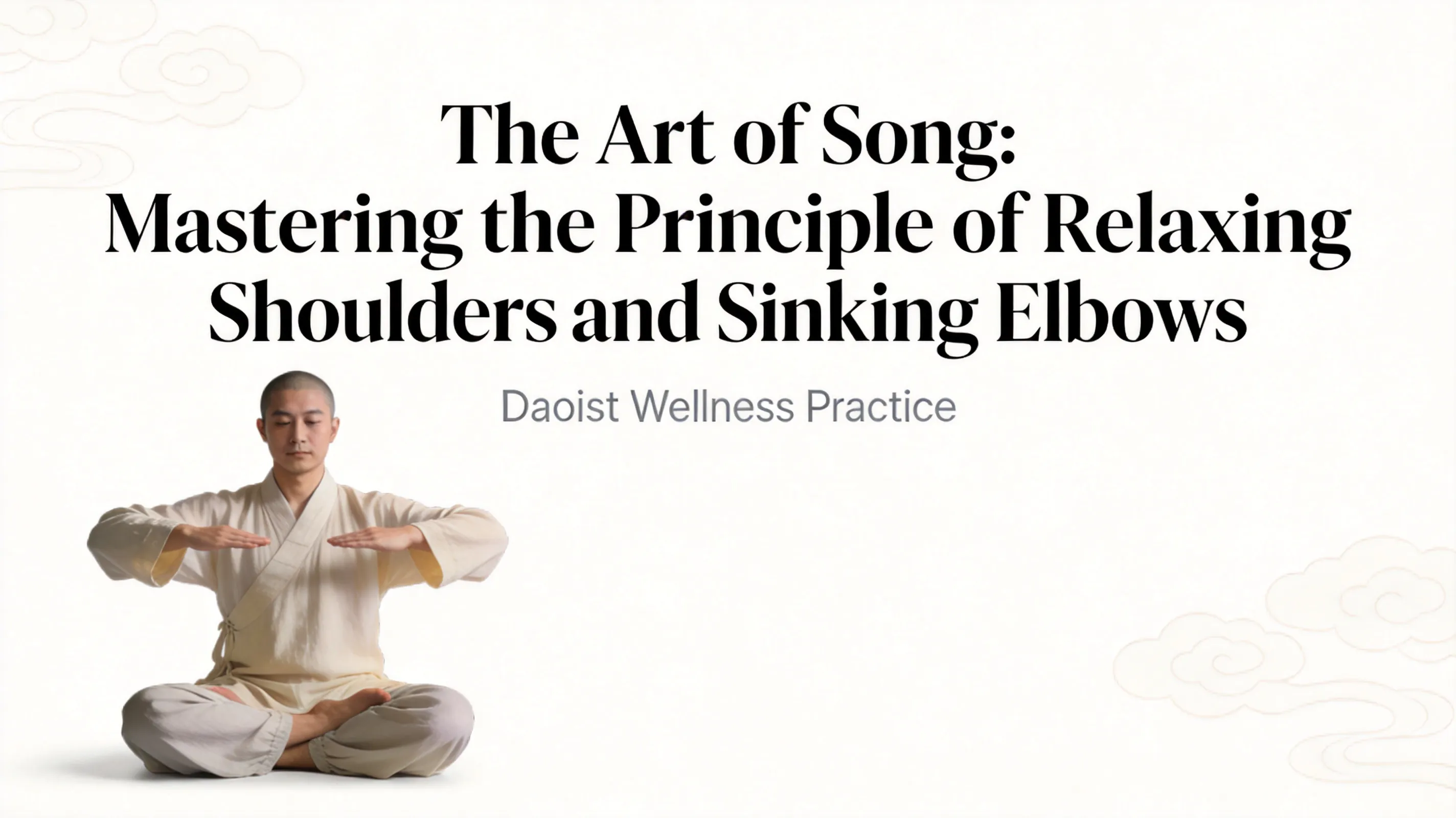
The Art of Song: Relaxing Shoulders and Sinking Elbows in Daoist Wellness
In the ancient traditions of Daoist health cultivation and internal martial arts, there is a fundamental phrase that serves as a cornerstone for both physical vitality and spiritual tranquility: "Song Jian Zhui Zhou." This translates directly to "Relax the Shoulders and Sink the Elbows." While it may sound like a simple postural correction, this instruction contains the profound wisdom of centuries of Neigong (internal work) and Qigong practice. It is the physical manifestation of the Daoist principle of Wu Wei—effortless action—applied to the human structure.
To the modern individual, the shoulders are often the reservoir for stress, anxiety, and the burdens of daily life. We carry our responsibilities in the tension of our trapezius muscles, subconsciously pulling our shoulders toward our ears in a perpetual "fight or flight" response. By learning to consciously release this tension and allow the weight of the arms to settle through the elbows, we do more than just improve our posture; we open the pathways for Qi (vital energy) to flow, stabilize our nervous system, and reconnect with the Earth’s grounding force.
The Philosophy of Release: Understanding "Song"
Before diving into the mechanics, we must understand the Daoist concept of "Song." Often translated as "relaxation," Song implies something much deeper than collapsing or becoming limp. In the Daoist view, Song is a state of active release. Imagine a piece of high-quality silk hanging from a hook; it is relaxed and soft, yet it possesses its own structural integrity and weight. When we "Song" our shoulders, we are not making them weak; we are removing the energetic blockages that prevent the body’s natural power from manifesting.
In Daoist cosmology, the human body is seen as a bridge between Heaven (Tian) and Earth (Di). The shoulders represent a major gateway where energy travels from the torso into the arms and hands. If the shoulders are tight, this gateway is closed. The energy becomes trapped in the upper chest and neck, leading to headaches, shallow breathing, and a sense of being "top-heavy." By sinking the elbows, we create a downward pull that encourages the shoulders to broaden and drop, facilitating a state of "rooting" where our center of gravity descends to the Lower Dantian (the energetic center in the lower abdomen).
The Physical and Energetic Benefits
Adopting the habit of relaxing the shoulders and sinking the elbows yields transformative benefits that span the physical, mental, and energetic realms. In the Daoist tradition, the body and mind are never viewed as separate; what affects the physical structure inevitably affects the spirit (Shen).
-
Enhanced Circulation of Qi and Blood: The axillary area (the armpit) contains vital lymph nodes, nerves, and blood vessels. When the shoulders are raised, these pathways are constricted. Sinking the elbows creates "hollow armpits," a state known as "holding an egg under the arm," which ensures that blood and Qi can circulate freely to the extremities.
-
Stabilization of the Nervous System: High shoulders are biologically linked to the sympathetic nervous system (stress response). By consciously dropping the shoulders, we signal to the brain that we are safe, shifting the body into the parasympathetic state (rest and digest), which lowers cortisol levels and promotes healing.
-
Improved Respiratory Function: Tense shoulders pull the ribcage upward, forcing the body into shallow "chest breathing." When the shoulders and elbows sink, the diaphragm is allowed to drop, enabling deep, abdominal breathing that oxygenates the blood more efficiently and massages the internal organs.
-
Structural Power and Balance: In Taiji and Qigong, power is not generated by muscle tension but by structural alignment. Sinking the elbows connects the arms to the core and the legs. This creates a unified body structure where force is distributed through the fascia rather than localized in the small joints of the shoulder.
-
Mental Clarity and Emotional Release: Daoists believe the shoulders hold the "weight of the world." Releasing them often leads to a spontaneous sense of emotional relief. As the physical tension melts, the mind becomes clearer and more resilient to external stressors.
The Mechanics of Sinking the Elbows
Sinking the elbows (Zhui Zhou) is the secret key to relaxing the shoulders. It is difficult to simply "relax" the shoulders through willpower alone because the muscles are often stuck in a chronic state of contraction. However, we can use the weight of the elbows as a physical anchor. Gravity is our greatest ally in this practice.
When the elbow "sinks," it feels as though a small weight is tied to the tip of the elbow, pulling it toward the ground. This downward pull creates a gentle stretch across the top of the shoulder (the acromion process) and the back (the scapula). This stretch naturally lengthens the neck and broadens the upper back. Importantly, the elbow should not be tucked tightly against the ribs; there should remain a sense of space, as if the arms are rounded and full, like holding a large beach ball or hugging a tree.
Practical Tips for Daily Cultivation
Integrating these principles into your life does not require hours of meditation; it requires consistent awareness and gentle adjustment. Here are several practical ways to cultivate relaxed shoulders and sunken elbows throughout your day.
-
The "Golden Thread" Visualization: Imagine a golden thread pulling the crown of your head toward the sky, lengthening your spine. Simultaneously, imagine your elbows are made of heavy lead, pulling your shoulders down away from your ears. This creates a "dual-directional stretch" that aligns the spine and relaxes the upper body.
-
The Breath-Release Technique: Inhale deeply and intentionally shrug your shoulders up to your ears, creating maximum tension. Hold for three seconds. As you exhale forcefully through your mouth, let your shoulders drop instantly, feeling the weight of your elbows pull them down. Notice the tingling sensation of blood returning to the area.
-
Checking Your "Armpit Space": Throughout the day—whether typing at a computer or driving—check if your armpits are collapsed. Imagine you are holding a fragile egg or a tennis ball under each arm. This visualization naturally encourages the elbows to sink and the shoulders to broaden without adding new tension.
-
Mindful Ergonomics: Adjust your workspace so that your elbows can remain at a 90-degree angle or lower. If your desk is too high, your shoulders must "hike up" to compensate. By lowering your keyboard or raising your chair, you allow gravity to assist in sinking your elbows.
-
The Daoist "Hollow Chest" Adjustment: Slightly round the upper back and allow the chest to "sink" or soften inward. This is not slouching; it is the release of the pectoral muscles. When the chest is soft, the shoulders naturally move forward and down, settling into their sockets rather than being pulled back in a rigid, military stance.
Advanced Practice: Connecting to the Spine
As you become more proficient in relaxing the shoulders and sinking the elbows, you will begin to feel a connection between the elbows and the Mingmen (the "Gate of Life" located on the spine directly opposite the navel). In Daoist internal arts, the elbows are energetically linked to the kidneys and the lower back. When the elbows sink, they should feel as though they are "tucking" the energy back toward the spine, rather than letting it leak outward.
This connection creates a powerful sense of "back power." Instead of using the small, easily fatigued muscles of the arms, you begin to use the large muscles of the back and the structural integrity of the spine. This is why a master of Taiji can move a heavy object with seemingly no effort; they are not "pushing" with their shoulders, but allowing the energy to flow from their rooted feet, through their relaxed shoulders, and out through their sunken elbows.
Overcoming Chronic Tension
For many of us, shoulder tension is chronic and deeply ingrained. It may feel "normal" to have tight shoulders, and the act of relaxing them might initially feel strange or even vulnerable. It is important to approach this practice with the Daoist spirit of "Ziran," or naturalness. Do not force the relaxation. If you find your shoulders have crept up again, simply acknowledge it and drop them again. Do this a thousand times a day if necessary. Over time, the nervous system will learn that the relaxed state is the most efficient and comfortable way to exist.
Massage, acupuncture, and heat therapy can be helpful adjuncts to this practice, as they help break up physical adhesions (Fascial restrictions) in the tissues. However, the most lasting change comes from the internal re-patterning of how you carry yourself. You are reclaiming your body from the imprints of stress.
Conclusion: The Path of Least Resistance
To relax the shoulders and sink the elbows is to stop fighting against gravity and start cooperating with it. It is an invitation to return to our natural state—a state where energy flows without obstruction, where the mind is calm, and where the body is both heavy and light. In the Daoist view, the way we hold our body is the way we hold our life. If we are rigid and tense, the world appears as a series of obstacles. If we are "Song"—relaxed, open, and grounded—we can navigate the complexities of life with grace and resilience.
As you move forward from this reading, take a moment to breathe. Feel the crown of your head lift, feel your shoulders melt like ice turning into water, and let your elbows settle into the pull of the Earth. In this simple alignment, you have found the beginning of the Daoist path to wellness—a journey of returning to the effortless flow of the natural world.