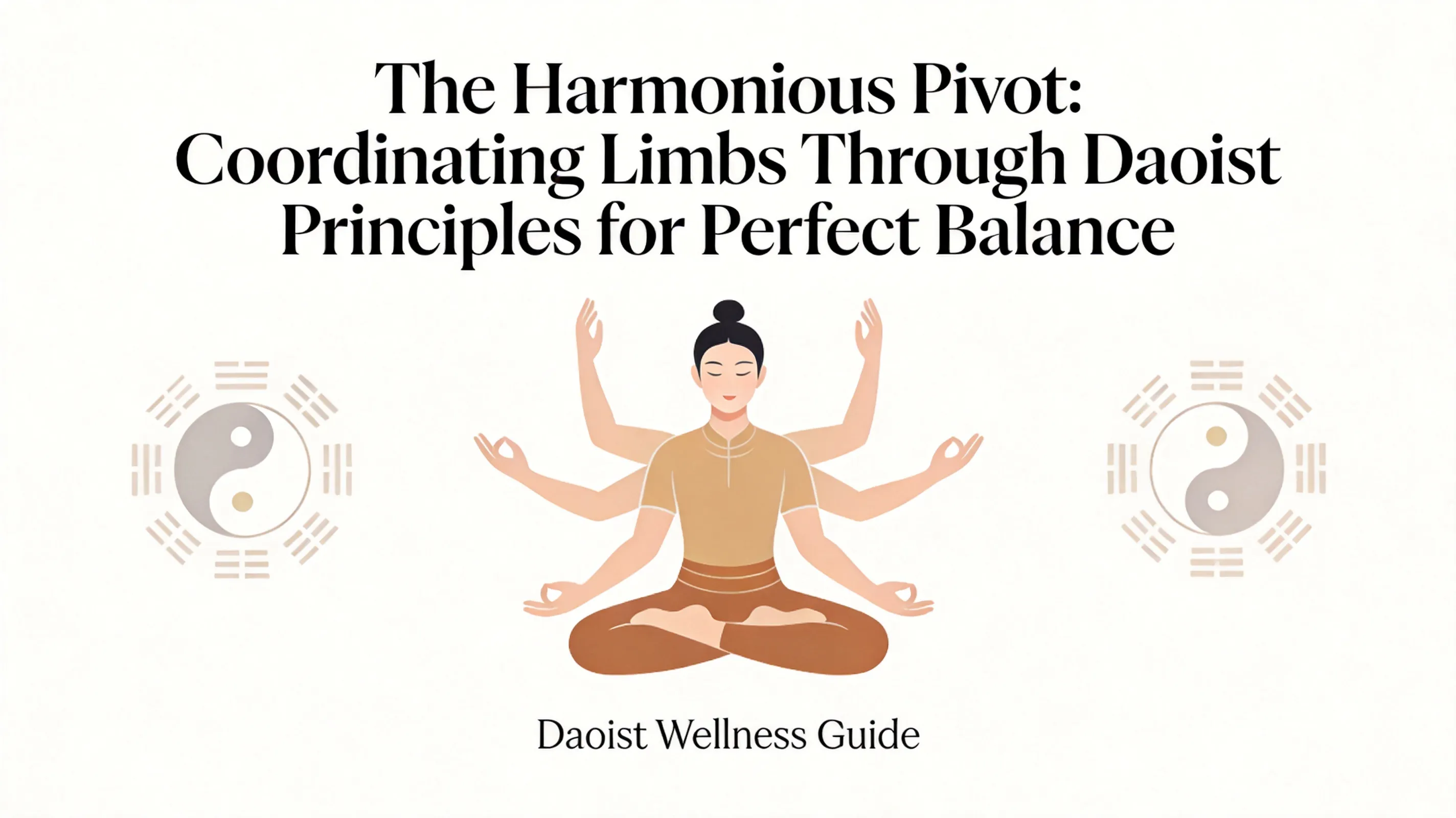
The Harmonious Pivot: Coordinating Limbs Through Daoist Principles
In the quietude of a mountain morning, one might observe the crane as it stands upon a single leg, or the willow branch as it yields to the wind without snapping. These are not merely feats of biology; they are expressions of the Dao, the underlying flow of the universe. In the practice of Daoist wellness, physical coordination is not viewed as a mechanical struggle of muscles against gravity, but as a sophisticated dialogue between the Earth and the Sky, mediated by the human body. To coordinate your arms and legs without losing balance is to achieve "Zhong Ding," or Central Equilibrium—a state where the physical structure and the energetic intention become one.
Modern life often fractures our natural grace. We sit for hours, causing our joints to stagnate and our internal awareness to wither. When we finally move, our limbs act as disconnected entities; the arms reach out while the legs remain heavy and unresponsive, or the feet move while the upper body lurches in compensation. This fragmentation is the primary cause of instability and falls. By returning to the foundational principles of Daoist movement—such as those found in Taiji and Qigong—we can relearn how to knit the body back into a singular, cohesive unit. This article explores the internal mechanics and philosophical shifts required to master total body coordination.
The Internal Architecture of Balance
To understand how to coordinate the limbs, we must first look at the "Three External Harmonies" (Wai San He). These are essential pairings that define Daoist movement theory: the shoulders must harmonize with the hips, the elbows with the knees, and the hands with the feet. When these joints are aligned and moving in synchronization, the body’s weight is distributed evenly, and the center of gravity remains rooted. If the hand reaches out further than the foot can support, the "Qi" (vital energy) is overextended, and balance is lost.
Central to this architecture is the "Dantian," located approximately two inches below the navel. In Daoist practice, this is the physical and energetic center of the body. True coordination does not begin in the hands or feet; it begins in the core. Think of the Dantian as the hub of a wheel, with the arms and legs acting as the spokes. If the hub is steady and turns with intention, the spokes move in perfect timing. When we move from the periphery—trying to balance by waving our arms or stiffening our legs—we are fighting against the natural laws of physics and energy.
Benefits of Integrated Movement
Mastering the coordination of the upper and lower body offers profound benefits that extend beyond mere physical stability. By training the body to move as a single unit, we tap into a source of longevity and mental clarity that is central to the Daoist path.
-
Enhanced Proprioception: Regular practice heightens your "body map," allowing you to know exactly where your limbs are in space without looking. This reduces the risk of stumbles and increases confidence in daily activities.
-
Neurological Plasticity: Coordinating complex, cross-lateral movements (where the opposite arm and leg work together) challenges the brain, fostering new neural pathways and improving cognitive function.
-
Joint Health and Longevity: When limbs move in harmony, no single joint bears excessive stress. The load is distributed across the entire kinetic chain, preserving the cartilage and ligaments of the knees and lower back.
-
Cultivation of Stillness in Motion: As the body becomes more efficient, the mind becomes calmer. The "internal noise" required to maintain balance subsides, leaving a state of relaxed alertness known as "Wu Wei" or effortless action.
-
Improved Circulation: Rhythmic, coordinated movement acts as a pump for the lymphatic system and blood, ensuring that nutrients reach the extremities and toxins are efficiently removed.
Practical Tips for Coordinating Arms and Legs
Transitioning from a state of disconnection to one of total body integration requires patience and mindful repetition. The following practical tips are designed to help you cultivate the "Golden Thread" of connection between your limbs.
1. Rooting Before Reaching
In the Daoist tradition, we say "the movement is rooted in the feet, released through the legs, controlled by the waist, and expressed through the fingers." Before you move your arms, ensure your weight is fully sunk into your "bubbling well" points (the center of the soles of your feet). When the lower body is stable like a mountain, the upper body can be light like a cloud. Never move your hands until you feel the ground supporting your stance.
2. The Law of Opposites
To maintain balance, the body must honor the principle of Yin and Yang. If one arm moves forward (Yang), there should be a counter-balancing awareness or subtle movement in the opposite leg or the other arm (Ying). This prevents the center of gravity from drifting too far in one direction. Practice walking slowly, ensuring that as your right foot steps, your left hand leads, creating a diagonal cross-brace of tension and support through your torso.
3. Use the "Waist" as the Commander
The "Yao," often translated as the waist or lower back/pelvis region, is the commander of movement. To coordinate your arms and legs, stop thinking about them as independent tools. Instead, turn your waist, and let that rotation pull the leg into a step and swing the arm into a reach. If the waist does not move, the limbs are merely "dead wood." When the waist turns, the whole body follows.
4. Maintain "Song" (Active Relaxation)
One of the greatest enemies of balance is "Li," or brittle muscular force. When we are afraid of falling, we stiffen our muscles. This stiffness actually makes us more like a top-heavy vase that is easily tipped. Daoist wellness emphasizes "Song"—a state of being relaxed yet structurally awake. By relaxing the muscles, you allow your weight to drop into the floor, and your joints to become "oiled" and responsive. A relaxed limb is much easier to coordinate than a rigid one.
5. Follow the Breath
The breath is the bridge between the mind and the body. To sync your limbs, sync them to your respiration. Inhale as you gather or pull back; exhale as you step or reach out. The expansion of the lungs naturally aids the extension of the limbs, while the contraction of the diaphragm helps stabilize the core. When the breath is jagged, the movement will be jerky. When the breath is smooth, the coordination will be fluid.
The Mental Aspect of Coordination
True balance is as much a mental state as a physical one. In Daoist philosophy, the "Yi" (intention) leads the Qi, and the Qi leads the blood and body. If your mind is scattered, your limbs will be scattered. When practicing coordination, visualize a central axis running from the crown of your head (the Baihui point) down through your perineum and into the earth. This is your "Taiji Pole."
As you move, imagine this pole remains vertical and unbroken. Your arms and legs circulate around this central stillness. By keeping your internal gaze on this axis, you provide your nervous system with a constant point of reference. This prevents the "mental vertigo" that often occurs when we try to track too many moving parts at once. Focus on the center, and the periphery will take care of itself.
Advanced Techniques: Crossing the Midline
Once basic standing and walking balance are achieved, the practitioner looks to more complex patterns. Crossing the midline—reaching the right hand toward the left side of the space, or stepping the left foot across the right—requires the brain to integrate both hemispheres. In Daoist arts, these "silk reeling" movements ensure that no part of the body becomes stagnant. To perform these without losing balance, one must focus on the "Kua" (the inguinal crease or hip fold). By folding the Kua deeply, you create space for the limbs to cross without pulling the spine out of alignment.
Practice these movements in "slow motion." The Daoists believe that speed hides errors, but slowness reveals the truth. By moving at one-quarter of your usual speed, you can feel the exact moment when your arm outpaces your leg, or when your weight shifts too far onto your toes. Correcting these micro-errors at slow speeds builds the "deep tissue memory" required for instinctive balance in fast-paced environments.
Cultivating the "Silk Thread" Connection
Imagine there is a fine silk thread connecting your right wrist to your left ankle, and your left wrist to your right ankle. If you move your hand too quickly, the thread snaps. If you move it too slowly, the thread sags. This mental imagery helps develop "Chen," or sinking energy. It creates a sense of "elastic tension" throughout the body. When you move, you aren't just moving bones; you are stretching and releasing this internal web. This feeling of being "strung together" is the secret to the effortless coordination seen in master practitioners of the internal arts.
Conclusion: The Path to Effortless Grace
Coordinating your arms and legs is not a goal to be reached through sheer willpower; it is a natural state to be recovered. We were born with this grace, as seen in the fluid movements of a crawling infant. Over time, stress, injury, and sedentary habits have built a "suit of armor" that prevents our parts from communicating with the whole. By applying the Daoist principles of rooting, centering, and softening, we begin to dissolve this armor.
Balance is not a static destination. It is a continuous process of adjustment and return. As you walk through the world, remember that you are a microcosm of the Dao. Let your legs be the Earth—solid, dependable, and deep. Let your arms be the Heavens—expansive, light, and expressive. Let your heart and your Dantian be the pivot that connects them. When the three are in alignment, you do not just move through the world; you dance with it, losing the fear of falling and gaining the freedom of the flow.
In the end, the coordination of the body is the first step toward the coordination of the life. When we move with integrity, we begin to think and act with integrity. The stability you cultivate on the soles of your feet will eventually manifest as stability in your spirit. May your path be steady, and your spirit be light.