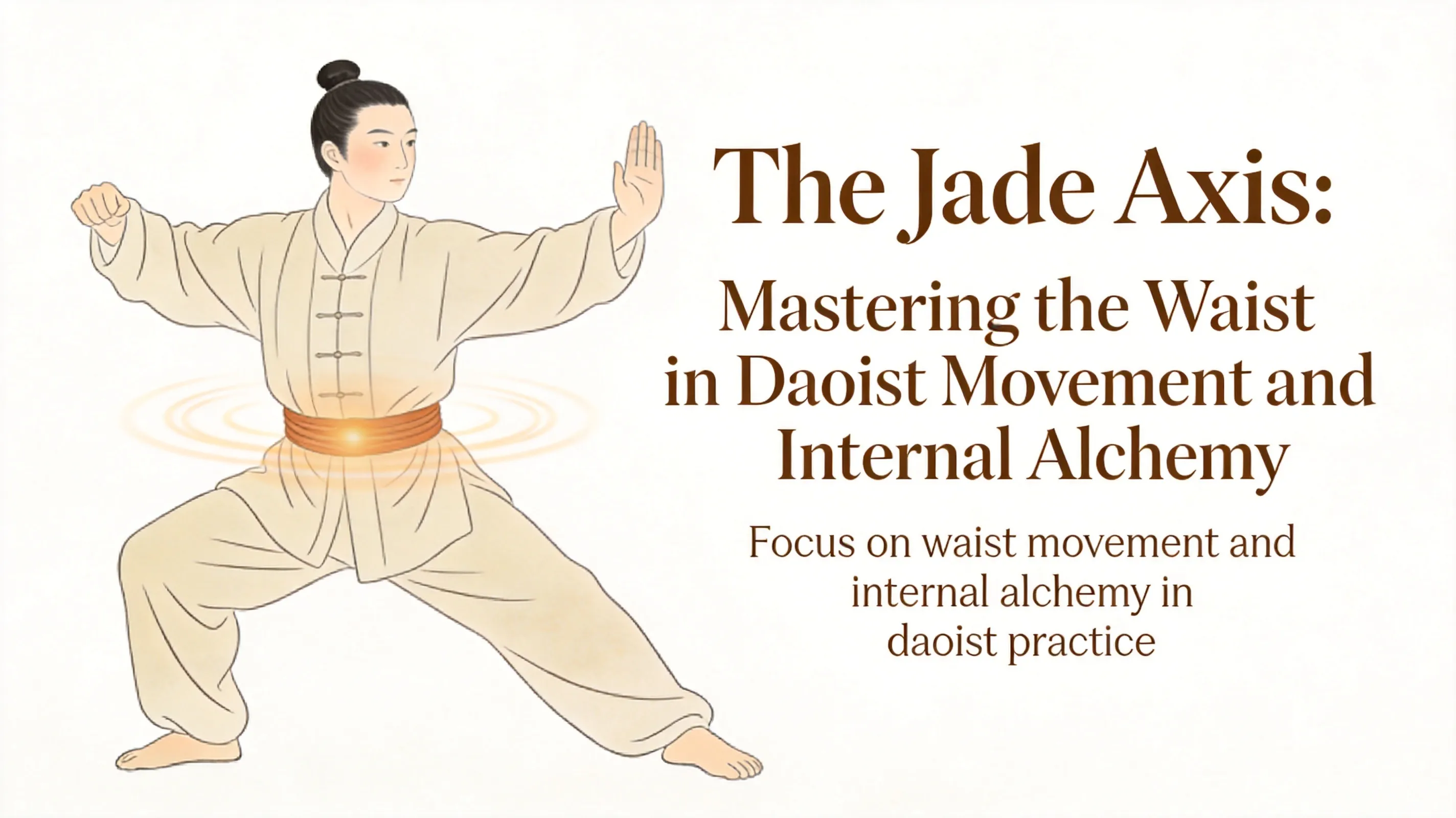
The Jade Axis: Mastering the Waist in Daoist Movement and Internal Alchemy
In the classical texts of Daoist internal arts, there is a recurring metaphor that describes the waist as the "commander" of the entire body. Whether practicing Taiji Quan, Qigong, or the subtle arts of Neigong, the waist—often referred to in Chinese as the Yao—serves as the primary horizontal axis upon which the vertical pillar of the spine rotates. In the Daoist worldview, the body is not a collection of disparate parts, but a unified energetic system. To understand the role of the waist is to understand the bridge between the lower foundation and the upper expression of spirit.
From a biomechanical perspective, the waist is the center of gravity. From a Daoist energetic perspective, it is the home of the Mingmen (the Gate of Life) and the engine that circulates Qi through the Dantian. When the waist is stiff, the flow of vital energy is obstructed, leading to stagnation in the organs and a lack of power in movement. When the waist is fluid and intentional, the entire body moves as a single, harmonious unit, echoing the Daoist principle of Wu Wei, or effortless action.
The Centrality of the Waist in Daoist Philosophy
Daoism teaches that the human body is a microcosm of the universe. Just as the North Star remains fixed while the heavens revolve around it, the waist serves as the pivot for all physical manifestation. In the Taiji Quan Jing (Classic of Taiji), it is stated: "The source of the energy is in the feet, it is developed in the legs, directed by the waist, and expressed through the fingers." This sequence is vital. Without the direction of the waist, the strength of the legs becomes "brute force," and the movement of the arms becomes "empty."
The waist acts as the steering wheel of the human vessel. In Daoist wellness, we differentiate between "waist movement" and "hip movement," though they are inextricably linked. The waist provides the rotational torque that allows the torso to spiral. This spiraling motion, known as Chan Si Jin (Silk Reeling Power), is essential for health because it gently massages the internal organs, particularly the kidneys and the liver, ensuring that blood and Qi do not stagnate in the abdominal cavity.
Furthermore, the waist is the physical container for the Lower Dantian, the reservoir of primordial Jing (essence). By focusing our awareness on the waist, we anchor our consciousness in the lower body, preventing the "ascending fire" of stress and overthinking from disturbing the heart and mind. A flexible and strong waist is therefore not just a physical attribute; it is a prerequisite for emotional stability and spiritual clarity.
The Benefits of Developing the Waist
Cultivating a "Daoist waist" offers profound benefits that extend far beyond the practice mat. In our modern sedentary culture, the lumbar region and the psoas muscles often become chronically tight or dangerously weak. Reclaiming the movement of the waist restores the natural order of the body.
-
Enhanced Circulation of Vital Energy: The Mingmen point, located on the spine directly opposite the navel, is considered the source of the body's fire. By rotating the waist, we "fan the flames" of the Mingmen, helping to distribute heat and energy to the extremities. This is particularly beneficial for those who suffer from cold hands and feet or low metabolic energy.
-
Structural Integration and Back Health: Many back injuries occur because the lumbar spine is forced to do the work that the hips and waist should be doing. By learning to rotate from the waist and hinge from the Kua (the inguinal crease), we take the pressure off the intervertebral discs. This creates a "suspended" feeling in the spine, allowing it to decompress naturally.
-
Improved Digestion and Organ Function: The twisting motions inherent in Daoist movement act as a manual squeeze-and-release for the digestive tract. This stimulates peristalsis and aids the gallbladder and liver in their detoxification processes. It is often said in Neigong circles that "a flexible waist leads to a long life" precisely because of its impact on the internal organs.
-
Dynamic Power and Balance: In the martial aspects of Daoism, power is never generated by the muscles of the arms. Instead, the waist acts as a torsion spring. When the waist turns, it carries the weight of the entire body behind a movement. This provides a sense of grounded power and improves balance, as the center of gravity is always consciously maintained.
-
Mental Grounding: By shifting our focus from the head to the waist, we enter a state of "embodied presence." This reduces anxiety and helps the practitioner feel more connected to the earth. In Daoist meditation, the movement of the waist during rhythmic breathing helps to settle the nervous system into a parasympathetic state.
The Mechanics of Direction: How the Waist Leads
To understand how the waist directs movement, one must visualize a revolving door. The central axis is the spine, and the waist provides the push that initiates the turn. In Daoist movement, we avoid "isolated" movements. If the hand moves, the waist must have moved first to put the hand in its new position. This is the secret to the fluidity seen in masters of Baguazhang or Taiji.
The waist acts as a transformer. It takes the linear, pushing force from the ground (the feet and legs) and converts it into rotational energy. This rotation then travels up the spine and out through the shoulders. Without this "middle manager," the energy from the legs would simply dissipate in the lower back, often causing pain. The waist ensures that the energy is refined and directed precisely where it needs to go.
This principle also applies to our direction in life. Daoist philosophy suggests that when our "center" is aligned and mobile, we can respond to the challenges of life with flexibility. Just as the waist can turn in any direction to face an opponent, a person with a cultivated center can adapt to changing circumstances without losing their balance.
Practical Tips for Cultivating the Waist
Developing the waist requires a combination of relaxation (Song) and mindful intent (Yi). It is not about forceful twisting, but about uncovering a natural, serpentine mobility that already exists within the human frame. Here are several practical approaches to integrating the waist into your daily life and practice.
-
The Golden Pivot Exercise: Stand with your feet shoulder-width apart and your knees slightly bent. Allow your arms to hang like heavy ropes. Slowly begin to rotate your waist from left to right. Let the momentum of the waist swing your arms, so they tap gently against your lower abdomen and lower back. Do not use your shoulder muscles to move your arms; let the waist be the sole engine of movement. Perform this for three to five minutes daily to break up stagnation.
-
Identify the Kua: The Kua is the area where the legs join the torso. To move the waist correctly, the Kua must be relaxed and "hollowed." Practice sitting into your hips as if you were about to sit on a high stool. This "opening" of the Kua provides the space for the waist to rotate freely without pulling on the knees.
-
Breathing into the Mingmen: Sit or stand quietly and place your awareness on the small of your back. As you inhale, imagine the breath expanding the lower back, gently pushing the Mingmen outward. As you exhale, feel the waist soften and contract. This "bellows breathing" strengthens the energetic connection to the waist.
-
Lead with the Belt Channel: In Chinese medicine, the Dai Mai (Belt Channel) is the only meridian that runs horizontally, encircling the waist like a belt. When you walk, imagine that the movement is initiated by this belt rather than your knees. Feel the waist turn slightly with every step, allowing the hips to swing naturally.
-
Vertical Alignment: The waist can only function as a pivot if the spine is vertical. Imagine a thread pulling the crown of your head toward the sky while your tailbone sinks toward the earth. This "stretching" of the spine creates the vertical space necessary for the waist to rotate without friction.
The Interplay of Stillness and Motion
In the higher levels of Daoist practice, the movement of the waist becomes so subtle that it is almost invisible to the casual observer. This is the transition from external movement to internal vibration. The "waist" is no longer just the muscular region of the obliques and the spinal erectors, but a magnetic center that pulses with the rhythm of the breath.
This internal movement is what directs the "Microcosmic Orbit," the flow of energy up the back and down the front of the body. The waist acts as a pump, assisting the ascent of Qi through the spine. When the waist is still, the mind can find a deeper level of quietude; when the waist moves, it does so with the authority of the whole being. This is the essence of the Daoist path: finding the stillness within motion and the motion within stillness.
Integration in Daily Life
The lessons of the waist are not confined to the practice hall. We can apply these principles throughout the day. When reaching for a glass in a cupboard, do not simply reach with the arm; turn the waist to bring the body closer to the object. When sitting at a desk, avoid collapsing the waist; keep the Mingmen "full" and alive. By treating the waist as the commander of all tasks, we turn mundane actions into a continuous practice of Qigong.
Over time, this constant mindfulness transforms the physical structure. The waist becomes supple, the internal organs remain vibrant, and the spirit feels more anchored. In the language of the Daoists, we are returning to the state of the "infant," whose body is perfectly soft and whose movements are naturally centered in the abdomen.
Conclusion
The role of the waist in generating and directing movement is perhaps the most critical "secret" of Daoist wellness. It is the bridge between the earth and the sky, the lower and the upper, the physical and the energetic. By refining our relationship with this central pivot, we do more than just improve our physical health; we align ourselves with the natural flow of the Dao.
As you move forward in your journey, remember that the waist is not something to be controlled through tension, but something to be liberated through relaxation. Let the commander be wise and gentle. Allow the waist to lead, the body to follow, and the spirit to remain at ease. In this harmony, we find the true path to longevity and internal peace.