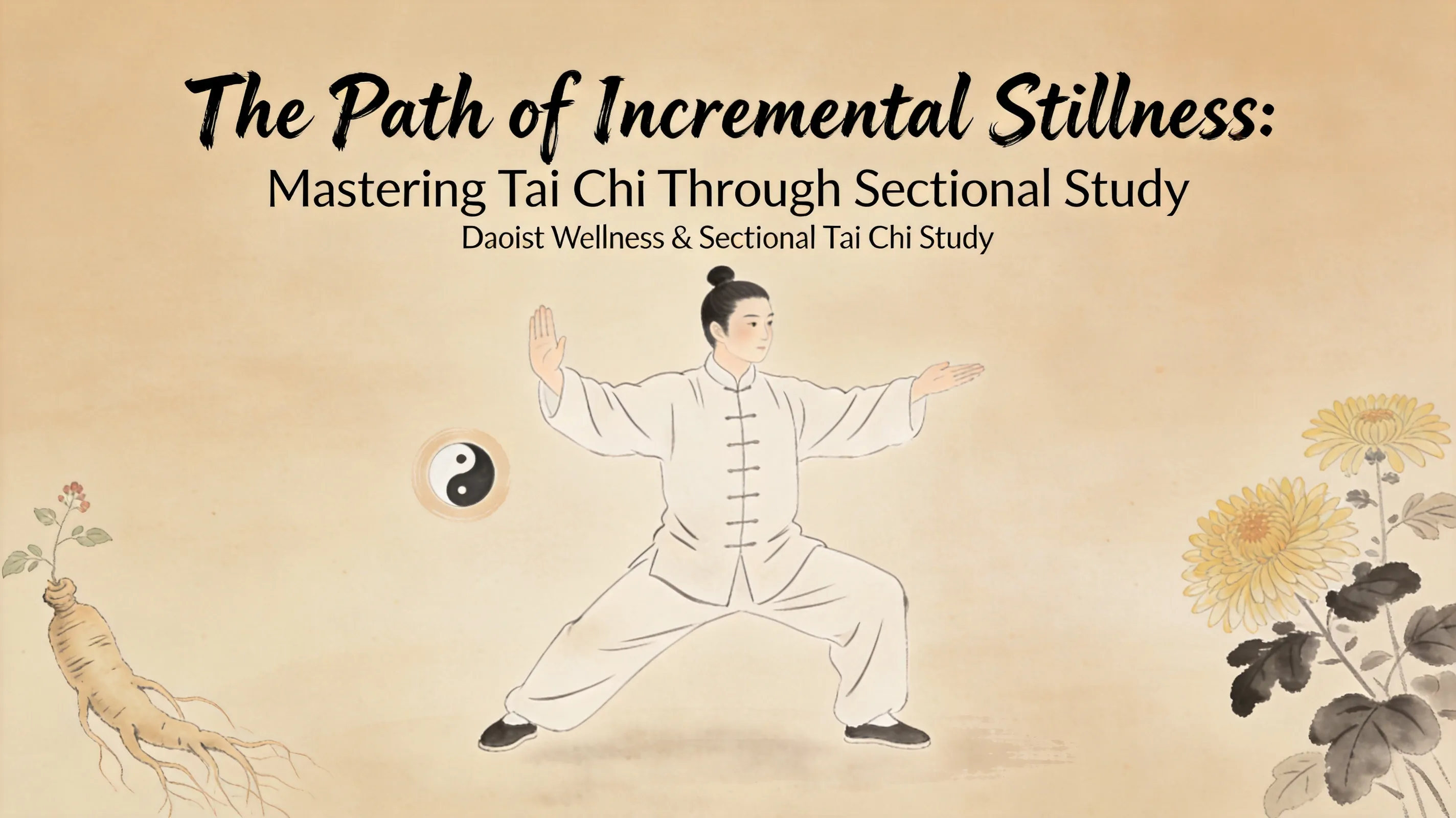
The Path of Incremental Stillness: Mastering Tai Chi Through Sectional Study
In the modern world, our minds are conditioned to seek the destination before we have even begun the journey. We look at the long, flowing sequence of a Tai Chi form and yearn to reach the end, believing that the completion of the choreography is the completion of the practice. However, from the perspective of Daoist wellness, the "form" is not a set of movements to be finished, but a vessel for cultivating the Three Treasures: Jing (essence), Qi (vital energy), and Shen (spirit).
To truly inhabit the principles of Daoism—wu wei (effortless action), yin and yang (balance), and the cultivation of the dantian—one must abandon the rush. The most profound method for internalizing these ancient arts is the discipline of sectional study. By focusing on one section of the form each week, the practitioner moves away from the superficiality of "doing" and enters the profound state of "being." This deliberate slowing down mimics the natural growth of a forest; it is steady, unhurried, and deeply rooted.
The Philosophy of Sectional Cultivation
Daoism teaches us that the macrocosm is reflected in the microcosm. The entire universe is contained within a single breath, and the entire Tai Chi form is contained within a single posture. When we rush to learn a 24, 42, or 108-movement sequence in a matter of days, we are merely scratching the surface of the skin. We are not yet touching the marrow.
Focusing on one section per week allows the nervous system to settle. In the Daoist tradition, the mind is often compared to a "monkey" that leaps from branch to branch. By restricting our focus to a specific set of movements—perhaps just the opening sequence or a single transitional turn—we tether the monkey mind to the breath and the physical sensation. This is where moving meditation truly begins. We are no longer thinking about what comes next; we are fully present in what is happening now.
This approach also honors the principle of "Song," or intentional relaxation. It is impossible to achieve true Song if the brain is overtaxed by trying to remember complex choreography. When the movements of a section become autonomous, the muscles can finally release their habitual tension, allowing the Qi to flow through the meridians without obstruction. We stop "performing" Tai Chi and start "allowing" Tai Chi to move through us.
The Benefits of Weekly Sectional Focus
-
Neurological Integration: By repeating a specific section for seven days, you facilitate neuroplasticity. The motor patterns move from the conscious, analytical brain to the subconscious, allowing for the fluid, "water-like" movement characteristic of high-level practice.
-
Deepened Proprioception: Focusing on a limited range of motion allows you to feel the subtle shifts in weight (Full and Empty) more acutely. You begin to notice the minute adjustments in the soles of your feet and the alignment of your crown, which are often missed when rushing through the full form.
-
Breath Synchronization: Tai Chi is often called "longevity breathing." When you focus on a small section, you can experiment with how the inhalation expands the frame and the exhalation settles the energy into the lower dantian. This synchronization is the key to tonifying the internal organs.
-
Reduced Performance Anxiety: Many practitioners feel overwhelmed by the length of traditional forms. Breaking the form into weekly sections transforms a daunting mountain into a series of beautiful hills, making the practice sustainable and psychologically nourishing.
-
Internal Alchemy (Neidan): True internal work requires the mind to lead the Qi (Yi Yi Zhi Qi). If the mind is busy remembering the next move, it cannot lead the energy. Sectional focus provides the mental space necessary for internal visualization and energy cultivation.
Structural Integrity: The Foundation of the First Week
If you are beginning this journey, the first week should always be dedicated to the "Preparation" and "Beginning" postures. In Daoism, the beginning contains the seed of the end. If your posture is collapsed or your weight is poorly distributed in the first thirty seconds, that disharmony will carry through the entire form.
During this week, your focus should be on the "Wu Chi" state—the state of primordial emptiness. Stand still. Feel the gravitational pull. Ensure your knees are not crossing the toes and your tailbone is gently tucked (the "suspension" of the coccyx). By spending a full week on just the opening, you build a foundation of "Peng" or ward-off energy that serves as the protective shield for your entire practice. You are not just standing; you are aligning yourself between Heaven (Tian) and Earth (Di).
Weekly Practical Tips for Sectional Mastery
To maximize the benefits of this focused approach, consider the following practical applications during your weekly study:
-
The Rule of Three Tempos: Practice your chosen section at three different speeds. First, move at your normal pace. Second, move as slowly as possible, as if moving through thick honey. Third, move slightly faster to test if your balance holds. This variation builds functional stability.
-
Isolate the Lower Body: Spend at least two days of your week practicing only the footwork of the section. Keep your hands on your hips and focus entirely on the "bubbling well" point of the feet. This builds the "root" that Daoist masters speak of.
-
Closed-Eye Visualization: After performing the section physically, sit in quiet meditation and perform the section in your mind. Research shows that mental rehearsal activates the same neural pathways as physical practice, deepening the mind-body connection.
-
The "Lining" Technique: Imagine a line of light connecting your fingertips to your dantian. As you move through your weekly section, ensure that this connection never "breaks." Every movement of the hand must be initiated by a turn of the waist.
-
Identify the Yin-Yang Points: In every section, identify which leg is "Full" (Yang) and which is "Empty" (Yin). Practice the transition between them until it is as smooth as silk being pulled from a cocoon.
Cultivating the Virtue of Patience
The Dao De Jing reminds us that "a journey of a thousand miles begins with a single step." In the context of Tai Chi, this means that the quality of your practice is more important than the quantity of movements you know. When you focus on one section per week, you are practicing the Daoist virtue of Zhi Zu (contentment).
There is a common trap in wellness circles to treat exercise like a commodity—something to be "acquired" quickly. But internal arts are a process of subtraction, not addition. We are subtracting tension, subtracting ego, and subtracting the need for speed. By the time you reach the third or fourth week of your sectional study, you will find that your body begins to crave the rhythm. The movements begin to "know" you as much as you know them.
Integrating the Sections
As you progress from week to week, you do not simply discard the previous section. Instead, you practice the new section in isolation for the majority of your session, and then spend the final ten minutes "weaving" it into what you have already learned. This is like building a chain link by link. The strength of the chain depends on the integrity of each individual loop.
This cumulative approach ensures that you never lose the "thread of Qi." By the time you have completed the entire form through sectional study, you will not just have memorized a dance; you will have built a sophisticated internal engine. You will find that the transitions between sections—the "invisible" parts of Tai Chi—become the most powerful moments of your practice.
The Impact on Daily Life
The beauty of the "one section per week" method is that it spills over into your life outside of practice. You begin to approach your work, your relationships, and your challenges with the same sectional focus. Instead of being overwhelmed by a large project, you see the "opening posture" of the task. You learn to apply the appropriate amount of energy to the specific moment, rather than wasting energy on future anxieties.
This is the ultimate goal of Daoist wellness: to live in harmony with the natural flow of time. Nature does not bloom all at once; it follows the seasons. Your Tai Chi practice should be no different. By honoring the season of each section, you allow your health to blossom in its own time, rooted in strength and reaching toward the sky.
Conclusion
Mastering Tai Chi through sectional focus is an act of rebellion against the frantic pace of modern existence. It is a return to the self and a commitment to quality over velocity. By dedicating yourself to one section each week, you move beyond the role of a student and begin the journey of a practitioner. You allow the principles of the Dao to move from the pages of ancient texts into the very cells of your body.
Remember that the goal is not to finish the form, but to refine the spirit. Whether you are working on the subtle turn of a palm or the grounding of a heel, do so with a heart of gratitude and a mind of stillness. In the quiet repetition of a single section, the secrets of the universe are waiting to be discovered. Slow down, breathe deep, and let the Dao guide your steps.