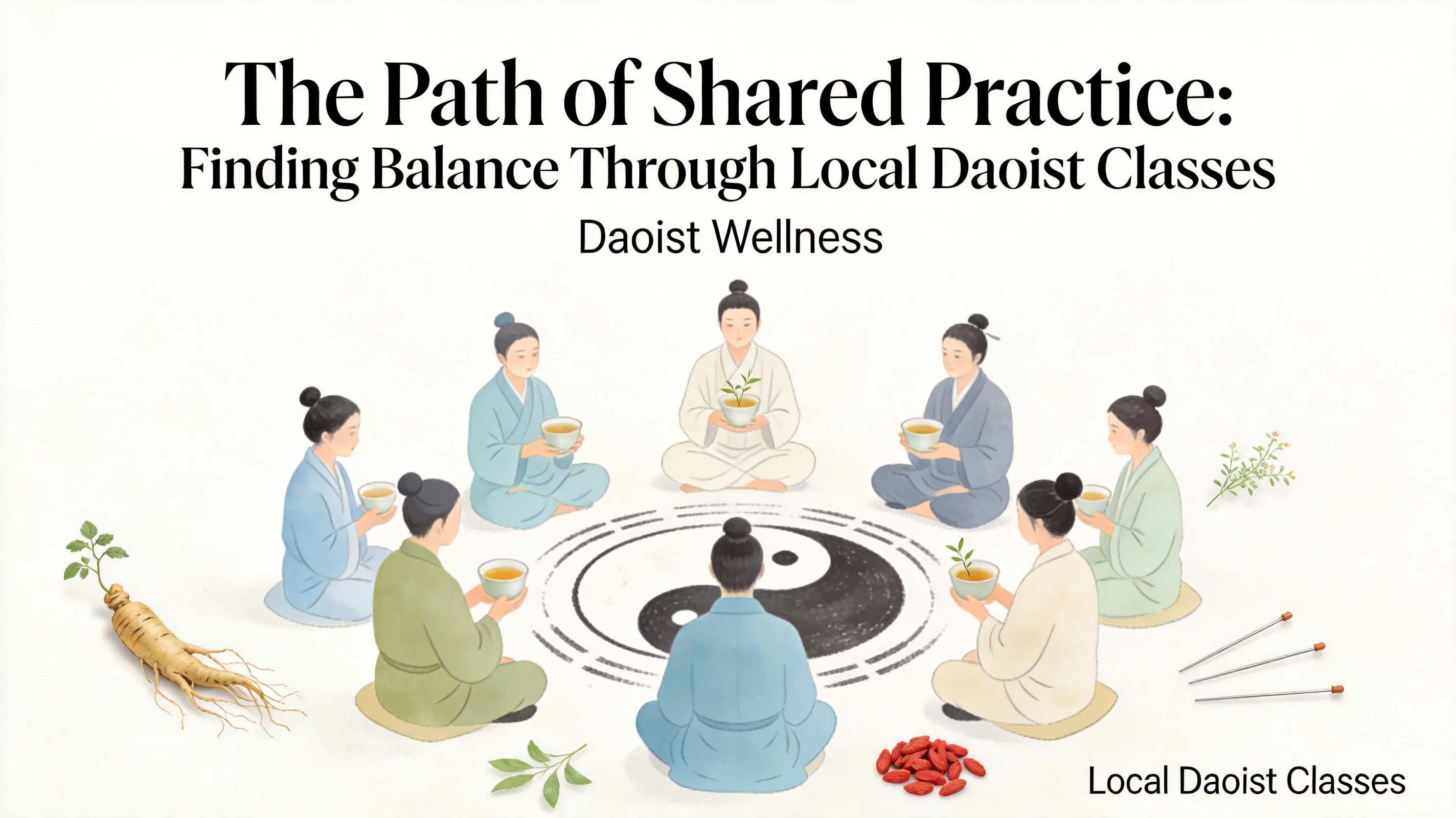
The Path of Shared Practice: Finding Balance Through Local Daoist Classes
In the modern era, our lives are often characterized by a profound sense of fragmentation. We move quickly between digital interfaces and physical responsibilities, frequently losing touch with the natural rhythms that sustain our vitality. This state of being, which the ancient Daoist sages might have described as a dispersal of Qi (vital energy), leads to exhaustion, mental fog, and a lingering sense of disconnection. To find our way back to center, many turn to the ancient wisdom of Daoism. While solitary study of the Dao De Jing or private meditation has its place, there is a unique and transformative power found in joining a local class for structured guidance and community.
The Daoist path is often likened to a river. While a single drop of water may struggle to find its way through the stones, a collective flow moves with purpose and strength. By entering a structured environment—whether it be for Tai Chi, Qigong, or internal alchemy—you align yourself with a lineage of wisdom and a group of fellow travelers. This article explores why the transition from solitary interest to communal practice is a vital step in the cultivation of Zhenren, or the "authentic person."
The Importance of Structured Guidance in Daoist Cultivation
At the heart of Daoist practice is the concept of Li, or the underlying pattern of the universe. In our personal cultivation, it is easy to mistake our own habits for natural flow. Without a mirror to reflect our progress, we may inadvertently reinforce physical tensions or mental biases. This is where the role of a qualified instructor and a structured curriculum becomes indispensable.
A structured class provides a map for the internal landscape. In the beginning stages of practice, we are often unaware of how much "noise" we carry in our nervous systems. An experienced teacher can observe the subtle alignment of your spine, the depth of your breath, and the tension in your joints. They offer corrections that are not merely physical, but energetic. When a teacher adjusts your stance in Zhan Zhuang (standing meditation), they are helping you remove the blockages that prevent the Earth’s energy from rising and the Heavens’ energy from descending through your central channel.
Furthermore, structured guidance ensures safety. Daoist internal arts involve the movement of Qi, which can be potent. Without proper sequencing—starting with Jing (the physical essence) before moving to Qi (energy) and Shen (spirit)—a practitioner may experience "fire" rising too quickly, leading to irritability or insomnia. A local class ensures that you build a solid foundation, honoring the natural progression of the elements within your own body.
The Power of the Collective Field: Community as a Catalyst
In Daoism, the concept of Zuo Wang, or "sitting and forgetting," suggests a dissolution of the ego. Paradoxically, this is often easier to achieve in a group than alone. When a group of people gathers with a shared intention of stillness and cultivation, they create a collective energetic field. This field acts as a container, holding each individual in a state of higher resonance than they might achieve on their own.
The community, or Sangha in a broader Eastern context, serves several Daoist functions:
-
Harmonizing Yin and Yang: Within a group, we encounter a variety of temperaments. Learning to practice alongside others helps us cultivate Wu Wei (non-effort or effortless action) in our social interactions. We learn to maintain our center while remaining open to the presence of others.
-
Accountability and Consistency: The Dao is a path of return, and the return requires persistence. The commitment to a weekly local class provides the external structure needed to overcome the "lazy dragon" of the ego, which often finds excuses to skip solitary practice.
-
Shared Reflection: After a class, the informal exchange of experiences can be deeply illuminating. Hearing a classmate describe a sensation of warmth or a sudden mental clarity can validate your own experiences and deepen your understanding of the Dao in a practical, lived sense.
Physical Benefits: Reclaiming the Vessel
Our bodies are described in Daoist texts as the "temples of the spirit." Before we can explore high-level meditation, we must ensure the vessel is strong, flexible, and clear. Joining a local class—specifically one focused on the physical arts like Tai Chi or Baguazhang—offers physiological benefits that are difficult to replicate through books or videos.
In a live class, you engage in "kinetic empathy." You are not just watching a screen; you are feeling the rhythm and weight of the teacher’s movements in the space around you. This direct transmission helps to:
-
Improve Proprioception: Understanding where your body is in space is essential for grounding. Group movement encourages a heightened awareness of your periphery, which calms the amygdala and reduces stress.
-
Regulate the Nervous System: Synchronized breathing in a group setting has been shown to entrain heart rates. This collective regulation moves the group from a sympathetic (fight-or-flight) state into a parasympathetic (rest-and-digest) state, allowing for deep cellular healing.
-
Enhance Bone and Joint Health: The slow, weight-shifting movements characteristic of Daoist arts require precise biomechanical alignment. A teacher ensures you are not putting undue pressure on your knees or lower back, facilitating the "silk-reeling" movements that lubricate the joints.
Mental and Emotional Sovereignty
Daoism teaches us that the mind and body are not separate entities but different densities of the same substance. When we join a class, we are training our "Heart-Mind" (Xin). In the quiet environment of a dedicated practice space, the chatter of the daily world begins to recede. This environmental cue is a powerful tool for mental discipline.
The structured nature of a class also helps in managing the "monkey mind." In a solitary setting, if a difficult emotion arises, we may be tempted to stop. In a class, the momentum of the group and the presence of the teacher provide the support needed to stay with the discomfort, observe it without judgment, and allow it to transform. This is the essence of Neidan (internal alchemy)—taking the "lead" of our heavy emotions and refining them into the "gold" of wisdom.
Practical Tips for Finding and Joining the Right Class
Embarking on this journey requires a blend of intuition and discernment. Not every class will be the right fit for your current stage of life. Here are several practical tips for finding a local community that aligns with your path:
-
Research the Lineage: While you don't need to be an expert in Daoist history, it is helpful to ask about the teacher’s background. A teacher who honors a specific tradition or lineage often brings a depth of practice that is rooted in centuries of refined wisdom.
-
Observe the Atmosphere: Before committing, ask to observe a class. Is the atmosphere one of quiet respect? Do the students seem relaxed or tense? A true Daoist environment should feel "natural" (Ziran)—free from excessive ego, competition, or rigid dogma.
-
Start with the Basics: If you are new to the path, look for "Foundational" or "Introductory" classes. Jumping into advanced forms without understanding the basic stances is like trying to write poetry before learning the alphabet. Focus on classes that emphasize Jing Zuo (quiet sitting) or basic Qigong sets like the Ba Duan Jin (Eight Brocades).
-
Consider the Location: The "local" aspect is important. Choosing a school that is easily accessible reduces the friction of attendance. Ideally, the space should be clean, well-ventilated, and free from excessive noise, serving as an urban mountain retreat.
-
Talk to the Teacher: A brief conversation can reveal much. A good Daoist instructor will listen more than they speak and will encourage you to progress at your own natural pace, rather than pushing you toward an arbitrary goal.
Integrating Class Teachings into Daily Life
The true measure of a Daoist class is not what happens on the meditation cushion or the practice floor, but what happens when you leave. The goal of structured guidance is to give you the tools to live more harmoniously in the world. As you learn to find your center in a Tai Chi form, you are also learning to find your center during a stressful meeting or a difficult family conversation.
Use the community as a touchstone. When you feel yourself drifting away from your practice, remember the faces of your classmates and the stillness of the practice hall. This "mental anchor" helps you maintain your cultivation throughout the week. You may find that you begin to eat more mindfully, breathe more deeply while walking, and respond to life’s challenges with a sense of De (virtue or inner power) that was previously inaccessible.
Conclusion: Returning to the Source Together
The journey toward the Dao is a journey back to our original nature—a nature that is inherently balanced, clear, and connected to all things. While the path is personal, it need not be lonely. By joining a local class, you bridge the gap between ancient theory and modern reality. You provide yourself with the structured guidance necessary to avoid the pitfalls of the ego and the community support required to sustain a lifelong practice.
In the Dao De Jing, it is said that "a journey of a thousand miles begins with a single step." Let that step lead you toward a local gate of practice. In the shared silence of a group meditation or the synchronized flow of a Tai Chi form, you will find that the Way is not a distant goal, but a present reality shared with those around you. Embrace the structure, cherish the community, and watch as your life begins to reflect the effortless grace of the Dao.