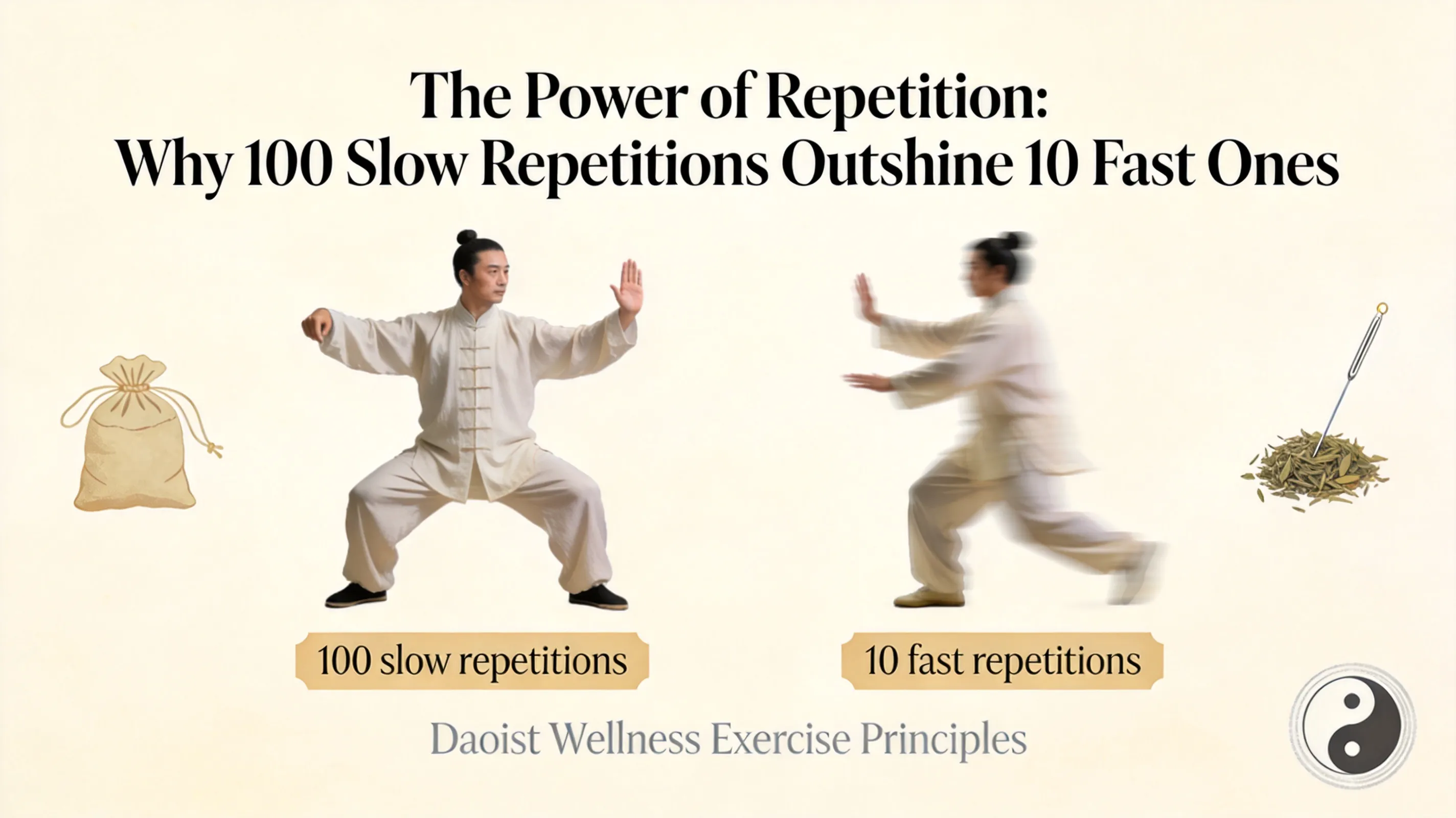
The Power of Repetition: Why 100 Slow Repetitions Outshine 10 Fast Ones
In our modern era, speed is often mistaken for efficiency. We are conditioned to believe that the faster we move, the more we achieve. However, within the ancient wisdom of Daoist wellness and internal alchemy, there exists a profound principle that contradicts this hurried approach: the power of mindful repetition. When we engage in 100 slow, deliberate repetitions of a movement rather than 10 hurried ones, we transition from mere physical exercise to a transformative cultivation of life force, or Qi.
The Daoist path emphasizes the "Water Way"—a method of softness, persistence, and gradual accumulation. Just as a steady stream of water eventually carves a canyon through solid rock, the repetitive, slow-motion movements of Tai Chi, Qigong, and Daoyin reshape the body and mind. This article explores the physiological and energetic reasons why slowing down and increasing your volume of movement is the ultimate secret to longevity and internal strength.
The Daoist Philosophy of Persistence and Flow
Central to Daoist practice is the concept of Bu Bu Wei Ying—taking each step with care. In the classic texts, it is suggested that the sage does not seek the destination but finds the Way within the journey itself. When we rush through 10 repetitions of a stretch or a strength movement, our focus is entirely on the result: the end of the set. When we commit to 100 slow repetitions, the ego eventually tires and surrenders, allowing the subconscious and the energetic body to take over.
This shift from the "doing" mind to the "being" state is where true healing occurs. Slowing down allows us to observe the micro-movements of our joints and the subtle shifts in our breath. In Daoism, this is known as Ting (listening) and Song (releasing). You cannot truly listen to the body or release deep-seated tension if you are moving at a pace that triggers the sympathetic nervous system’s "fight or flight" response.
The Physiological Benefits of 100 Slow Repetitions
While modern fitness often focuses on muscular hypertrophy through high intensity, the Daoist approach prioritizes the health of the fascia, tendons, and the nervous system. Here is why the high-volume, low-speed approach is superior for long-term wellness:
-
Fascial Hydration and Elasticity: Fascia, the connective tissue that envelopes our muscles and organs, responds best to slow, rhythmic loading. Rapid movements can cause the fascia to tighten or even tear. Slow, repetitive movements act like a sponge being squeezed and released under water, pulling fresh fluids into the tissue and maintaining youthfulness.
-
Neuromuscular Integration: Every movement is a conversation between the brain and the motor units. By performing 100 repetitions slowly, you create deep "grooves" in the nervous system. This builds "Silk Reeling" power—a type of integrated strength where the whole body moves as a single unit.
-
Bone Density and Joint Health: High-impact exercise can be hard on aging joints. Conversely, slow repetition provides a gentle, consistent pressure that signals the body to deposit minerals into the bone matrix without the risk of acute injury.
-
Cardiovascular Efficiency: It is a misconception that exercise must be fast to benefit the heart. Slow, deep movement coupled with diaphragmatic breathing improves vascular tone and helps the heart pump blood more efficiently by utilizing the "second heart" of the calves and the rhythmic pressure of the breath.
The Energetic Perspective: Cultivating Qi
In the realm of Qigong, movement is a vehicle for the breath, and the breath is a vehicle for Qi. If you move too fast, the breath becomes shallow and the Qi becomes scattered. By performing 100 repetitions at a slow pace, you create a "rhythmic resonance" in the body.
This repetition acts as a form of moving meditation. Around the 30th or 40th repetition, the superficial muscles begin to fatigue, and the body is forced to find a more efficient way to move. This is when the internal "coiling" power begins to manifest. You stop using localized muscular tension and start using the structural alignment of the skeleton and the flow of internal energy. The 100th repetition is not an ending, but a state of peak refinement where the movement feels effortless—this is Wu Wei, or non-doing, in action.
Psychological Mastery and the Quiet Mind
One of the greatest challenges in wellness is the "monkey mind"—the restless thoughts that distract us from the present moment. Fast exercise often feeds this restlessness; we use music or screens to distract ourselves from the intensity. However, 100 slow repetitions require a different kind of mental fortitude. They demand presence.
When you commit to a high number of slow repetitions, you encounter boredom, impatience, and frustration. These are the very mental "blocks" that Daoists seek to dissolve. By staying with the movement, breathing through the impatience, and returning your focus to the sensation of the palms or the soles of the feet, you train the mind to remain calm under pressure. This translates directly to daily life, allowing you to handle stress with a composed and centered spirit.
Practical Tips for Implementing Slow Repetition
Transitioning from a "fast and few" mindset to a "slow and many" practice requires a shift in perspective. Use the following guidelines to begin your journey into Daoist-style repetition:
-
Start with a Simple Movement: Choose a movement that does not require complex balance, such as "Cloud Hands" from Tai Chi or a simple arm circling exercise. The simplicity allows you to focus entirely on the quality of the motion.
-
Synchronize with the Breath: Let the movement follow the breath. Inhale as the chest expands or the arms rise; exhale as the body sinks or the arms descend. If the movement becomes too fast for the breath, slow down the movement even further.
-
Focus on the Joints: As you repeat the movement, scan your body. Are your shoulders hunched? Is your lower back arched? Use each repetition to "polish" your posture, dropping the tailbone and relaxing the neck.
-
Use the "Rule of 70%": In Daoist wellness, we never push to 100% of our physical limit. Use only 70% of your strength and range of motion. This prevents the body from tensing up and ensures that the energy can flow freely through the joints.
-
Count Mindfully: Use the counting as a mantra. If you lose track of the count, simply start again from a number you remember. The goal is not the number itself, but the unbroken thread of attention.
The Cumulative Effect: Building the "Golden Ball"
There is a specific phenomenon that occurs during high-volume slow practice often referred to as "building the ball." As you move your hands through the air repeatedly and slowly, the air begins to feel thick, almost like water or magnets. This is the sensation of the Wei Qi (protective energy) field becoming concentrated.
Ten fast repetitions are like a flash of hay on a fire—hot, but quickly extinguished. One hundred slow repetitions are like a thick log that burns steadily for hours. This steady "cooking" of the internal system refines the Jing (essence) into Qi (energy) and eventually into Shen (spirit). This is the foundation of the Daoist Internal Alchemical process, leading to a state of vibrant health and spiritual clarity.
Common Pitfalls to Avoid
Even with the best intentions, the ego may try to subvert a slow practice. Be wary of these common mistakes:
-
Mechanical Movement: Do not let the repetitions become robotic. Every single repetition should be as fresh and vital as the first one. Avoid "tuning out."
-
Over-Efforting: If you find yourself gripping your teeth or holding your breath to reach 100, you are moving too fast or using too much force. Relax. Song is more important than the count.
-
Skipping the Warm-up: While slow movement is gentle, the body still benefits from a light opening of the joints (like gentle ankle and wrist circles) before embarking on a long set of repetitions.
Conclusion: The Path of Least Resistance
The power of repetition is not found in the strain of the muscles, but in the refinement of the intent. By choosing 100 slow repetitions over 10 fast ones, you are choosing depth over surface, quality over quantity, and longevity over temporary gains. You are aligning yourself with the natural laws of the Dao, where the soft overcomes the hard and the slow overcomes the fast.
In your next practice session, set aside the stopwatch and the desire for intensity. Choose one simple movement, breathe deeply into your lower Dantian (the energy center below the navel), and begin your 100 repetitions. You will likely find that by the time you reach the end, you are not exhausted, but rather filled with a calm, vibrant energy that stays with you long after the practice has ended. This is the true gift of the Daoist way: a body that is supple, a mind that is still, and a spirit that is free.