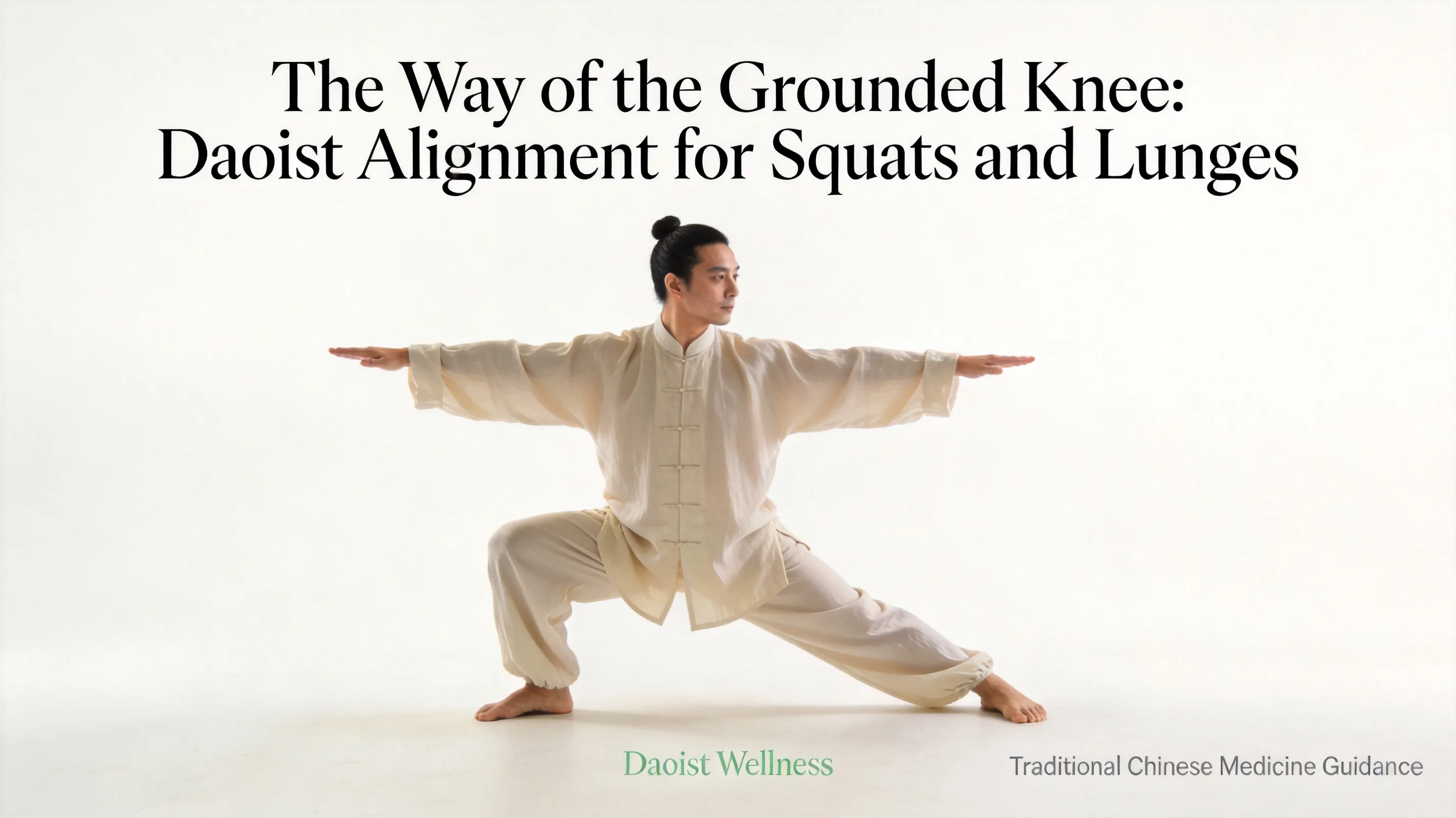
The Way of the Grounded Knee: Daoist Alignment for Squats and Lunges
In the ancient traditions of Daoist cultivation, the body is viewed not merely as a machine of muscle and bone, but as a vessel for the flow of Qi—the vital life force. To the Daoist practitioner, physical movement is a form of moving meditation, a way to harmonize the internal landscape with the external world. Central to this harmony is the concept of structural integrity. When we engage in foundational movements like squats and lunges, we are participating in the primal dance of Earth and Heaven. However, if our alignment is fractured, the flow of Qi is blocked, leading to what modern science calls joint pain and what Daoism recognizes as stagnation.
The knee is a bridge. It connects the rooted power of the feet to the creative flexibility of the hips. In Daoist wellness, the knee is often seen as a vulnerable gate. If the gate is misaligned, the energy of the Earth cannot rise to nourish the body, and the weight of the Heaven (the upper body) becomes a crushing burden. This article explores how to refine your alignment in squats and lunges, blending modern biomechanics with timeless Daoist principles to ensure your practice leads to longevity rather than injury.
The Philosophy of the Golden Mean in Movement
Daoism teaches the path of the "Zhong Yong" or the Golden Mean—the middle way. In the context of a squat or a lunge, this means finding the perfect balance between tension and relaxation, between pushing and yielding. Many fitness enthusiasts approach these exercises with a "hard" energy, forcing the body into positions it is not yet ready to inhabit. This excessive Yang energy creates friction in the patellofemoral joint.
Conversely, a lack of engagement, or excessive Yin, leads to collapsing arches and inward-buckling knees (valgus stress). Proper alignment is the physical manifestation of "Wu Wei"—effortless action. When the bones are stacked according to their natural design, the muscles can support the structure without unnecessary strain. We do not fight the movement; we flow with it.
The Benefits of Proper Knee Alignment
Aligning the knees correctly transcends simple pain prevention. It transforms the exercise into a rejuvenating practice. The benefits include:
-
Preservation of Jing: In Daoist medicine, the kidneys and bones are the storehouse of Jing (ancestral essence). Protecting the joints from wear and tear prevents the premature depletion of this vital essence.
-
Enhanced Rooting: When the knee tracks correctly over the foot, the "Yongquan" point (Kidney 1) on the sole of the foot remains grounded, allowing you to draw energy from the Earth.
-
Fluidity of Sinews: Daoism emphasizes the health of the tendons and ligaments over bulk muscle. Proper alignment ensures that these tissues stay supple and elastic.
-
Mental Stillness: When the body is aligned, the mind is not distracted by signals of pain or instability, allowing for a deeper state of presence during training.
-
Longevity (Chang Shou): By avoiding the chronic inflammation of joint shearing, you ensure that you can remain mobile and active well into your later years.
The Foundation: The Tripod Foot and the Bubbling Spring
Before we address the knee, we must look at the foundation. In Daoist movement arts like Tai Chi and Qigong, the foot is the commander of the knee. If the foot is unstable, the knee will inevitably suffer. To protect your knees during squats and lunges, you must establish the "Tripod Foot."
The tripod consists of three points: the base of the big toe, the base of the little toe, and the center of the heel. During a squat or lunge, these three points must remain in firm contact with the earth. If your arch collapses, your knee will rotate inward, placing immense stress on the medial collateral ligament. By consciously pressing into the "Bubbling Spring" (the depression behind the ball of the foot), you activate the inner arch and create a stable base that keeps the knee tracking safely.
The Squat: Sitting into the Jade Gate
The squat is a natural human resting position, yet many have lost the ability to perform it safely. From a Daoist perspective, the squat is about "opening the Kua"—the inguinal fold or the crease of the hip. When the hips are tight, the body compensates by shoving the knees forward or allowing them to cave in.
To align the knees in a squat, imagine your tailbone is weighted with a heavy stone, pulling you straight down toward the center of the earth. As you descend, your knees must follow the direction of your second and third toes. This is the "path of least resistance." If the knees drift inward, you are fighting your own anatomy. By pushing the knees gently outward so they stay over the feet, you create space in the pelvis, allowing the Qi to sink into the lower Dantian (your energetic center).
A common error is the "knee-dominant" squat, where the knees shoot far past the toes before the hips have moved. While it is not inherently "evil" for the knees to pass the toes, doing so prematurely increases the shearing force on the patella. Instead, think of sitting back into an invisible chair, keeping the shins as vertical as possible for as long as possible. This distributes the load into the glutes and hamstrings—the "Yang" muscles of the legs—rather than the delicate "Yin" structures of the knee cap.
The Lunge: Walking the Path of Balance
Lunges represent the transition between stillness and motion. They are inherently more unstable than squats because the center of gravity is shifted. In Daoist practice, this requires a "Double-Weighted" awareness. You must be equally mindful of the front leg and the back leg.
The most frequent cause of knee pain in lunges is the "leaking" of energy forward. If the front knee crashes forward and the heel lifts, the energy is trapped in the front of the knee. To fix this, ensure that your front shin remains nearly perpendicular to the floor at the bottom of the lunge. The weight should be centered through the middle of the foot, not the toes.
Furthermore, the back knee should drop straight down, creating two 90-degree angles. This maintains the integrity of the "Dai Mai" (the belt vessel or the horizontal channel around the waist). When the spine is upright and the knees are aligned, the energy circulates freely through the torso. If you lean too far forward, you compress the chest and put excess pressure on the front knee joint.
Practical Tips for Daoist Alignment
Refining your movement requires a blend of physical adjustments and mental visualizations. Here are practical steps to ensure your knees remain healthy:
-
The "Spiral" Technique: As you squat or lunge, imagine your feet are "screwing" into the ground. Your right foot rotates clockwise and your left foot counter-clockwise (without actually moving them). This external rotation torque stabilizes the hip and keeps the knee from collapsing inward.
-
Gaze at the Horizon: In Daoism, the "Shen" (spirit) leads the Qi. If you look down at your feet, your energy collapses. Keep your chest open and your eyes on the horizon. This naturally aligns the spine and prevents the forward tilt that stresses the knees.
-
Breathe into the Kidneys: As you descend into a squat or lunge, inhale and feel your lower back expand. This "internal pressure" acts as a cushion for the spine and helps you maintain a vertical posture, taking the load off the quadriceps and the knee joints.
-
Listen to the "Whisper" of Pain: Daoist wellness is about sensitivity. Pain is a "shout" from the body. Before the shout, there is a whisper—a slight tightness or a dull ache. If you feel this, stop and adjust your alignment. Never "push through" joint pain; it is a sign that you are out of harmony with the Way.
-
The Soft Knee: Even when standing straight, never lock your knees. A locked knee is a "dead" joint where Qi cannot flow. Always keep a "micro-bend," maintaining a sense of springiness and readiness.
The Role of the Hips and Ankles
The knee is often a victim of its neighbors. In Daoist medicine, we say "the problem is rarely where the pain is." If your ankles are stiff (restricted Yang), your knees will overcompensate by moving too much. If your hips are tight (restricted Yin), the knees will twist to find range of motion. To protect the knees, one must cultivate "Song"—a state of intelligent relaxation—in the hips and ankles.
Incorporate ankle mobility drills and hip-opening stretches into your routine. When the joints above and below the knee are free, the knee can fulfill its true purpose as a simple hinge, moving back and forth without the destructive lateral or rotational forces that cause injury.
Cultivating the Inner Landscape
Beyond the physical, the health of the knees is tied to our emotional state. In Traditional Chinese Medicine, the knees are governed by the Kidneys, which are the seat of fear and willpower. A person who moves with fear often tenses the muscles around the knee, creating a "bracing" effect that leads to chronic pain. Conversely, one who moves with excessive ego (over-willpower) may ignore the body's limits.
Practice your squats and lunges with a sense of "An" (peace). Approach the movement as an exploration of your own temple. When you move with reverence for your body, your alignment naturally improves because you are listening to the subtle cues of your nervous system. This is the essence of Daoist wellness: the union of the mind's intent (Yi) and the body's movement.
Conclusion: The Path to Lasting Strength
The journey to pain-free knees is not found in complex machinery or expensive supplements, but in the return to natural law. By aligning your knees with your feet, opening your hips, and grounding your energy into the Earth, you transform squats and lunges from mere exercises into rituals of vitality.
Remember that the body is a reflection of the Dao. It seeks balance, flow, and efficiency. When we align our physical structure with these universal principles, pain disappears as a natural consequence of harmony. Treat your knees as the sacred gates they are. Move with the wisdom of the ancients—slowly, mindfully, and with a deep connection to the ground beneath you. In doing so, you will find that strength and longevity are not goals to be reached, but the natural results of walking the path in correct alignment.
May your movement be fluid like water and your foundation as solid as the mountain. This is the Way of the grounded knee.