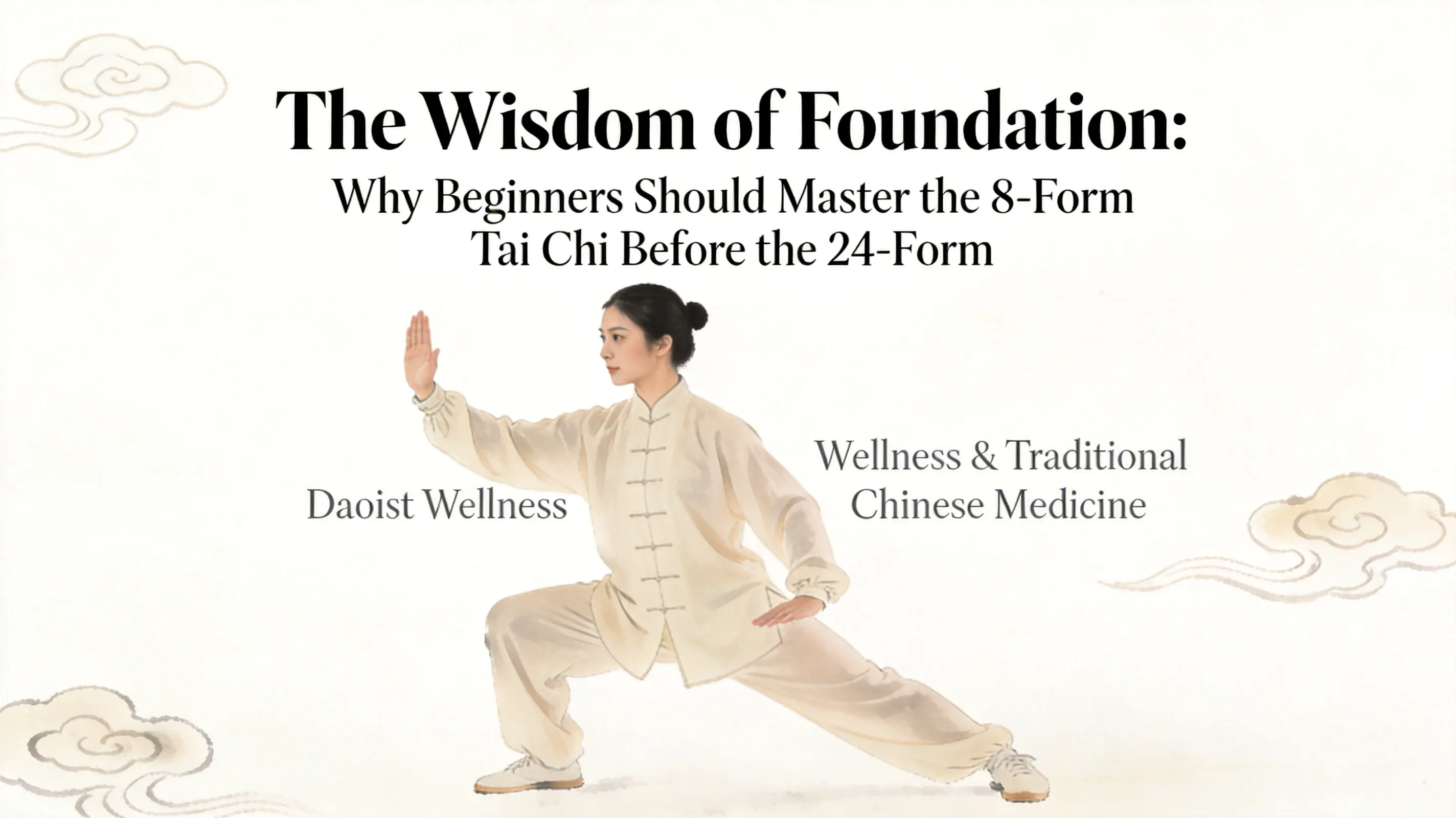
The Wisdom of Foundation: Why Beginners Should Master the 8-Form Tai Chi Before the 24-Form
In the modern world, we are often driven by a desire for rapid progress and the acquisition of complex skills. We look at the sprawling elegance of a master performing the 24-form Tai Chi Chuan—the most popular standardized routine in the world—and we wish to jump immediately into that flowing river. However, from the perspective of Daoist wellness and internal alchemy, the shortest path is rarely a straight line. True mastery is built upon the cultivation of Zhong Ding (central equilibrium) and the refinement of the fundamental breath. For the seeker of health and longevity, the 8-form simplified routine is not merely a "beginner’s version"; it is the essential seed from which all greater forms grow.
The Dao De Jing reminds us that "the journey of a thousand miles begins with a single step." In the context of Tai Chi, that step is the mastery of basic structural alignments. By choosing the 8-form over the 24-form at the start of your journey, you are practicing the Daoist principle of Wu Wei—effortless action. You are choosing to align with the natural progression of your body’s learning capacity rather than forcing a complex choreography onto a mind and body that have yet to learn how to relax.
Understanding the Essence of the 8-Form Tai Chi
The 8-form, often referred to as the "Easy 8" or the Simplified Tai Chi routine, was designed specifically to distill the core essence of the Yang style into a manageable sequence. While the 24-form is already a condensation of the traditional long forms, it still requires significant spatial awareness, memory, and physical stamina. The 8-form focuses on the core pillars of the art: the brush knee, the repulse monkey, the cloud hands, and the golden rooster stands on one leg.
In Daoist thought, the number eight is significant. It represents the Bagua, or the eight trigrams, which symbolize the fundamental principles of reality. When we practice the 8-form, we are not just doing a short workout; we are harmonizing the eight directions of our internal energy. This smaller sequence allows the practitioner to focus on the Neigong (internal work) rather than getting lost in the Waigong (external movement). If the mind is busy trying to remember which foot moves next in a 24-step sequence, it cannot focus on the sinking of the Qi to the Dantian.
The Benefits of Starting Small: A Daoist Perspective
The benefits of prioritizing the 8-form are both physiological and spiritual. By narrowing the scope of your practice, you deepen the quality of your experience. Here are the primary reasons why this foundational approach leads to superior long-term results:
- **Cultivation of Deep Relaxation (Song):** The most difficult aspect of Tai Chi is not the movement, but the release of unnecessary tension. In a shorter form, you can constantly scan the body for "kinks" in the energy flow.

- **Refinement of Balance:** The 8-form includes essential weight-shifting exercises. Without a solid foundation in how to transition weight from "Full" to "Empty," the 24-form becomes a series of stumbles rather than a flow of energy.

- **Breath Synchronization:** It is nearly impossible for a beginner to coordinate their breath with 24 distinct movements. The 8-form provides a tight loop where breath and motion can become one.

- **Lowering the Barrier to Consistency:** Daoism emphasizes the "daily drop of water that carves the stone." A five-minute 8-form routine is easy to perform every morning, ensuring that your *Qi* is regulated daily.

- **Neuroplasticity and Confidence:** Completing a form perfectly provides a psychological boost. This sense of mastery prevents the frustration that often leads beginners to abandon their practice when faced with the complexity of the 24-form.
The Structural Integrity of the 8-Form
In the practice of Tai Chi, we often speak of the "Six Harmonies." These include three external harmonies (shoulders with hips, elbows with knees, and hands with feet). Achieving these harmonies requires an intense level of self-awareness. When a student attempts the 24-form too early, their "frame" often collapses. Their shoulders rise, their lower back arches, and their knees overshoot their toes. This not only blocks the flow of Qi but can lead to physical injury.
The 8-form acts as a laboratory. Because the movements are few, you can focus on the "Three Point Alignment"—the crown of the head pulling upward (Baihui), the tailbone tucking slightly to open the Mingmen (the Gate of Life), and the feet rooting into the earth. Once these structural habits are ingrained in the 8-form, they will naturally carry over into the 24-form, making the latter much easier to learn and far more effective as a health practice.
Transitioning from Movement to Stillness
A core tenet of Daoist wellness is that "within movement, there is stillness." For a beginner, the 24-form is often too "busy." The mind is racing to keep up with the sequence. The 8-form, however, is short enough that it can quickly become "moving meditation." Once the sequence is memorized—which usually takes only a few sessions—the practitioner can stop thinking about the "what" and start feeling the "how."
This transition is where the true healing power of Tai Chi resides. When the mind settles into the movement, the nervous system shifts from the sympathetic (fight or flight) to the parasympathetic (rest and digest) state. This shift is essential for tonifying the internal organs and balancing the endocrine system. By mastering the 8-form first, you learn how to access this state of "active stillness" much faster than you would by struggling through the longer choreography of the 24-form.
Practical Tips for Mastering the 8-Form
To gain the most from your foundational practice, consider these Daoist-inspired tips for your daily training:
- **Focus on the Bubbling Spring:** As you move through the 8-form, keep your awareness on the *Yongquan* point (the ball of the foot). Feel your connection to the Earth's energy in every transition.

- **Lead with the Waist:** The *Yao* (waist) is the commander of the body. In the 8-form, practice initiating every arm movement from the rotation of the waist rather than the muscles of the shoulders.

- **Visualize the Resistance:** Imagine you are moving through water or thick air. This visualization helps to engage the internal muscles and slows the movement down to a therapeutic pace.

- **Practice in Small Spaces:** One of the beauties of the 8-form is that it requires very little space. Use this to your advantage. Practice in your bedroom or a small office to emphasize the "internal" nature of the work.

- **Seek Circularity:** Daoist philosophy emphasizes the circle. Ensure that your transitions in the 8-form are rounded and continuous, avoiding any sharp angles or abrupt stops.
Why the 24-Form Benefits from This Patience
When you eventually move to the 24-form, you will find that it is composed largely of the movements you perfected in the 8-form, simply arranged in a more complex pattern with additional transitions like "Snake Creeps Down" or "Step Forward, Deflect, Parry, and Punch." Because you have already mastered the 8-form, you will have the "vocabulary" necessary to read the "sentences" of the 24-form.
Without the 8-form foundation, the 24-form often becomes a "dance"—it looks like Tai Chi on the outside, but it lacks the internal substance (Jin). By being patient, you ensure that your 24-form is a genuine expression of internal martial arts. You will find that you learn the 24-form in half the time it would have taken otherwise, and with ten times the depth of feeling.
Conclusion: Embodying the Dao Through Simplicity
The path of Tai Chi is a path of returning to simplicity. While the 24-form is a beautiful and culturally significant routine, it is the mastery of the simple, the small, and the foundational that transforms the body and mind. By dedicating yourself to the 8-form, you are honoring the Daoist virtue of Pu—the uncarved block. You are keeping your practice pure, focused, and deeply rooted.
Do not rush to the mountain peak; instead, learn to love the soil at the base. As your roots grow deep through the practice of the 8-form, your branches will naturally reach for the sky, and the 24-form will unfold within you like a flower in spring. This is the way of natural growth, the way of health, and the way of the Dao.
Let your practice be a source of joy rather than a chore of memorization. Start with the eight, find your center, and let the energy flow. The rest will follow in its own perfect time.